Sharing Rambling, Resources and Recipes for Learning in Life

Sharing Rambling, Resources and Recipes for Learning in Life

Author: Audrea

EducationFaithRamblings

Moving from Systemic Racism to Systemic Change

I, like so many others, am struggling with what to say. I know what happened to George Floyd is wrong. I know that his death is the latest in a long line of wrongful deaths NOT an isolated incident. I know that things have to change. I know that I want better for my brother and for my future nieces or nephews. I know that most police officers are good. I know that color is a part of who we are, but that it is only a part. I know that I want to be a part of the solution, not just NOT a part of the problem. I know I am broken hearted and I am sorry. That’s about all I know!

I have been watching and I have been listening. I have been doing my best to be open and trying to understand. And, to be honest, I feel like I am hearing a lot of different information and expectations. So, I am left unsure of what to do and say. I have gone back and forth on what to say or if to say. But there are a few things that have been repeated in most if not all of the things I have heard and watched and seen. One of them is that silence is complicit. So, I will share some of the action steps I have heard asked for from me.

Something I have heard as well is that there are a lot of white people, like myself, who want to do whatever we need to do to help move our nation from systemic racism to systemic change. We agree that what has happened is wrong! We agree that we don’t understand! We agree that we have been a part of the problem explicitly or complicitly and we want to be a part of the solution instead!

Some of the action steps I have heard asked for in order to make this change are education, conversation and advocacy.

We should educate ourselves about what IS happening in our country right now that perpetrates or flat out is racism. We must also educate ourselves on the history of racism in our country, so that we can understand the depth of the pain and cost to the black/African American community. We must educate ourselves on what we have or are doing to perpetrate this racism. We must educate our children on the importance of color as a gift to us from God. A gift of diversity meant to deepen, strengthen, and broaden our individual experiences. You see perspective is a powerful thing. It can totally skew reality to a mirage or it can change a mirage into reality. This is because by it’s own definition perspective is limited. It only shows one side or a partial view of anything. That doesn’t mean that perspective is a bad thing, just that it needs to be recognized for it’s limitations. We must take our perspectives and talk to others about their perspectives and remain open enough to REALLY listen to their perspectives and allow their perceptions and perspectives to be added to ours to allow for a more rounded reality. This is one of the most valuable kinds of education we must seek out because it will likely come from our friends and family of other colors and perspectives than ours. And, we can gain the most for those that mean the most to us. We must also be committed to educating our children. We must educate them that all people are valuable because they are people. They are valuable because they are created in the image of God. We must also take it a step further and educate ourselves and our children to advocate and stand up for others when we witness racist or even divisive actions.

The other thing that I have heard asked for is conversation. Find a family member or friend who is ready to talk and have the uncomfortable conversations AND I would add the comfortable ones. Have true relationships. Invest in each other and find out the good, the bad and the ugly together. This investment will pay dividends in developing a broader perspective and the ability to move from sympathy to empathy. That move is another thing that I have heard asked for and Christians commissioned to make. If you do not have the blessing of a friend or family member who is a person of color, then I would encourage you to involve yourself in one of the multiple conversations that people of color are offering on Social Media. They are offering to listen to and answer your questions. The other thing to remember is that these will not be comfortable conversations and NONE of us are ready to have them until we are ready to truly listen. This means we are willing to hear ugly things about ourselves and that we are committed to changing those things. Also, just like racism is not the fault of person’s of color, but is a reality that they have to face, every racist action or reality may not be our fault, but changing it and bringing healing from it IS our responsibility.

I know there is much more to hear, learn and do. These are just a couple of the things I have heard asked for and that I am committing to doing a better job of.

The other MORE important thing I am committing to is prayer. Prayer changes impossible things. Prayer changes impossible people. Prayer changes me. MOST importantly prayer brings the Prince of Peace and the only Perfect Intercessor into an impossible situation. Left to ourselves we focus on ourselves and maybe on our families sometimes. We see our perspective as the whole picture and we leave no room for other’s perspectives to change ours. Prayer helps us to have God’s perspective (the only one that sees the whole picture). Prayer helps lead us to and in the humility we need to change who we are into who we were meant to be.

I hope this post is helpful. I hope this post shows that I am listening, learning and changing. I hope and pray that this post brings comfort to the hurting and glory to Jesus! I pray for each of you and I have SO much to learn. What action steps have you given or heard. Please share so that we can learn from each other!

EducationRamblingsResourcesScience of Reading

C vs. K; Unlocking the Spelling Mystery with the C and K Rules

The sound /k/ is one of the sounds with the most variants in it’s spellings. You can spell this sound using a c or a k or the letter combination of ck. That can make it seem very complicated to know how to correctly spell this sound. Fortunately there are rules to help guide us to know which spelling to use when.

We will start with c. You can use the letter c to spell the sound /k/ which is called the hard sound of the letter c at the beginning of words or the end of words. It can be used at the beginning of words when the letter coming after the /k/ sound is an a, o, u or any consonant. Some words that show this are cat, cot, cut and crash. You can use it for the /k/ sound at the end of words, but generally only after the short i sound as in the suffix -ic in the word iconic or in a words like epic. One of the best ways I have seen to remember the times to use c for the /k/ sound at the beginning of words is a drawing of a cat. Cat starts with a c because the next letter is an a. In the picture of the cat, the eyes are a’s, the nose is an o and the mouth is a u. The collar on the cat has the word consonants on it. Below is a picture of the cat that has everything but the consonant collar. I downloaded this picture as a free download from Ashley Ann on Teachers Pay Teachers. And here is a link to a sort that I have in my store, Basics Rethought, at Teacher’s Pay Teachers for students to use for practice or as proof of mastery after learning about the rules for both c and k at the beginning of words.

Use c to spell /k/ before an a, o, u or any consonant!

The letter k is used to spell the sound /k/ before an e, i or a y. Examples of this are key, kite, and the name Kyle. The best way that I have seen this represented is with a kite. I am posting a photo of the kite below, again from the free download from Ashley Ann on Teachers Pay Teachers. The reason we must use a k to spell /k/ before these letters is because when c comes before the letters e, i, and y, it makes it’s soft sound /s/ instead of the /k/ sound. Examples of this are city, center and cyclone. This information needs to be taught to students with the above information about using the letter c to spell /k/ at the beginning of words before students are ready to use my c/k Picture sort. K is also used at the end of words when the /k/ sound follows a consonant sound or a long vowel sound like in trunk and meek. K is also the spelling for /k/ in silent or magic e words as in make or like. This is because when c is followed by a silent e it makes it’s soft sound of /s/ instead of the hard sound of /k/ as in mice.

Use the letter k to spell /k/ before an e, i or y.

Our last rule to talk about today is for using c and k together to spell the /k/ sound. -ck is used to spell the /k/ sound at the end of one syllable words when it comes directly after a short vowel sound as in the word duck. This is the reason you will often see a hyphen in front of -ck on Phonics cards or in teacher’s manuals or writings about Phonics. The hyphen stands in for the rest of the word that would come before the -ck since -ck is only used at the end of words.

That’s it!

Use c to spell /k/ at the beginning of words before an a, o, u or any consonant.

Use k to spell /k/ at the beginning of words before an e, i, or y.

Use c to spell /k/ at the end of words following the short i sound.

Use k to spell /k/ at the end of words after a consonant or long vowel sound or in a silent e word.

Use -ck to spell /k/ at the end of one syllable words directly after a short vowel sound.

Please share how it goes teaching these rules to your learners! If you have specific questions I can help, with please comment below. If you find this post helpful in teaching your reader please like or comment below! Thanks for reading this, happy reading AND happy teaching!!

ParentingRecipes

Smothered Pork Chops

Delicious, SUPER simple Smothered Pork Chops

This recipe is another of the surprises I concocted for NannaLee and the girls when we were over for our weekly visit. For those who may have missed the post about the Beef Alfredo Casserole from the week before, Nanna and I have started playing a “game” when the girls and I come to visit. Our “game’ is that Nanna chooses and thaws her choice of meat for our lunch and then I am left to find something to go with it in her fabulously stocked pantry. It has become one of the highlights of our week to go see her and I know it blesses her. When Papa passed away and she moved into her “retirement” house, it was the first time to live all by herself. The isolation of self quarantining after her recent missions trip to Peru really took a toll on her VERY social soul! In addition to this it is such a blessing for the girls to learn form her and to be treasured by her. Grand and Great Grand Parents are SUCH a gift for children and families.

The meat of her choice this week was pork chops. Her pork chops were VERY thick, close to two inches. So, since she had two of them and there were four of us and they were so thick I sliced each one in half. I decided to try a version of smothered pork chops, then added a box of quinoa and wild rice mix as a side and we rounded out the meal with a bagged Caesar Salad. This week Brinley helped with the quinoa and mixed up the salad for lunch. She really loves cooking and I was so impressed about three weeks ago when she basically made dinner herself at home and made an easy version of Parmesan Chicken. Everyone including myself gave these pork chops an A+ rating. I was concerned that it might be a little bland, but it was very flavorful in my opinion. So without further ado, here is the recipe.

Smothered Pork Chops:

4 Pork Chops

1 can Cream of Mushroom Soup

1 can of mushrooms or mushroom pieces

Salt and Pepper (optional)

2 tbsp Olive Oil

Smothered Pork Chops Directions:

  1. Put the oil in a skillet and heat over medium heat
  2. Salt and pepper both sides of the pork chops (optional to taste preference)
  3. Place the pork chops in the skillet and cook for 1-2 minutes on each side, just long enough to sear the meat
  4. Turn off the burner and remove the skillet from heat
  5. Preheat the oven to 250 degrees
  6. Spoon the can of mushroom soup onto the top of the chops (dividing it equally between all four chops)
  7. Pour the juice/water from the mushrooms over the whole skillet
  8. Pile mushrooms on top of the soup on top of each pork chop
  9. Salt and Pepper the whole skillet (optional to taste preference)
  10. Place the whole skillet into the preheated oven for 10-20 minutes based on the thickness of the pork chops
  11. Turn the oven up to 375 degrees and cook an additional 5-7 minutes until everything is bubbling around the edges
  12. I slice one of my chops through the middle to ensure doneness
  13. Serve immediately

I hope this recipe is useful and delicious for your family. I was pleasantly shocked at how yummy it was since it was SO simple and had so few ingredients! If you try it please like this post or leave a comment sharing how it goes for you! What are some of your favorite simple recipes?

EducationRamblingsResourcesScience of Reading

Phonics, the base of it all!

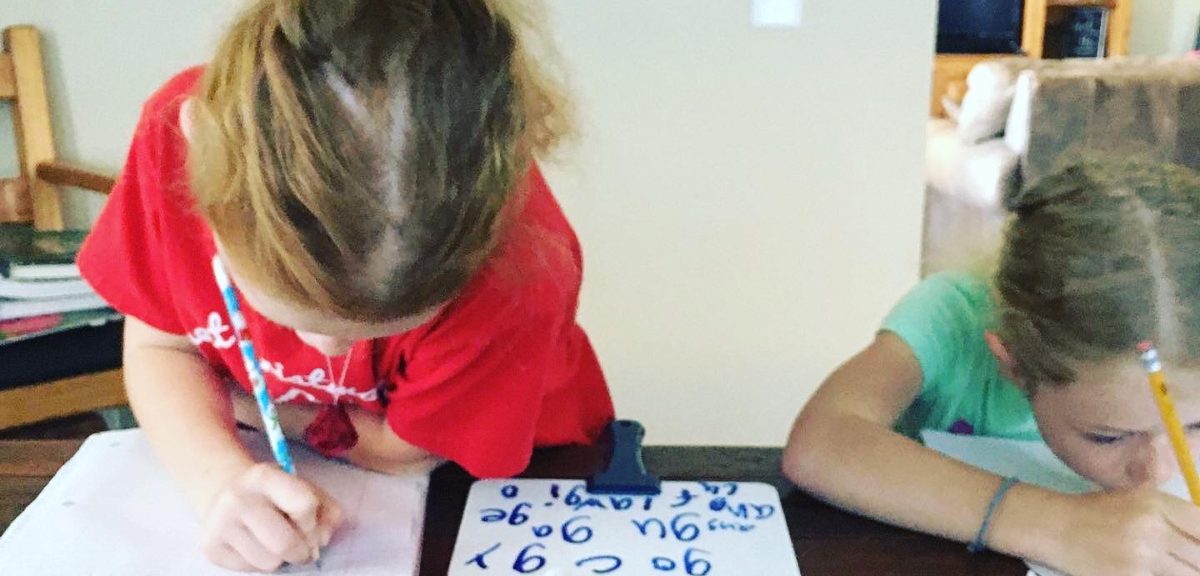
Yes, they did their own hair this day! They were SO excited to do Phonics together today!

Phonics is the first step that all of the oral work with language takes toward building a strong relationship with written language. The word phonics is based on the root phon or phone which means sound. You may remember from my post on Phonemic and Phonological Awareness that the suffix -ic means “having to do with or in regards to”. That means at its “root” (pun intended!!) Phonics just means having to do with sound. And that is what it is. It is teaching children what sounds each letter makes. ALL of the sounds each letter makes (long and short vowel sounds, soft and hard c and g sounds, or multiple sounds for a digraph). It is also what sounds different digraphs, trigraphs, quadgraphs, diphthongs, and vowel teams make.

Here is some more information about what each of those letter combinations are. Di-, tri- and quad graphs are just letter combinations that make a new/different sound. Di is a root that means two, so these are the two letter combinations of sh, ch, wh, and ph. Tri means three so that includes combinations like igh, tch, dge. Quad means four so that means a four letter combination like eigh. Diphthongs are vowel or vowel and consonant combinations that make a blended or new sound. Some examples of these are ou, ow, oi and oy. Vowel teams are two vowel combinations that follow the rule of “when two vowels go walking, the first one does the talking and says its name”. The term vowel team is used for various combinations in different programs and trainings, but to me there are only 6 true vowel teams because they include only vowels and they follow the above rule. They are ea, ee, oe, oa, ai, and ie.

Once learners have mastered with BOTH accuracy and automaticity the sounds of the letters, they can start using their Phonemic Awareness skills to put those sounds together to sound out AND spell words. This is a key thing to remember. True phonics should include instruction in both decoding (reading) and encoding (spelling) words. Learners do not have to have all the letter combinations mastered before starting to use phonics to read and spell. In fact they can begin using their Phonological skills to read and write as soon as they have mastered with accuracy and automaticity as few as two letter sounds like /a/ and /m/ or /o/ and /n/. As learners are working on and mastering their letter sounds they should be using them to read and write as soon as possible. Doing this will help their learning in two ways. First, it will help them see the value of what they are learning and help them remain engaged in the learning. Second, it will help ingrain their learning deeper as they practice applying their new knowledge in different ways.

This is essentially all that Phonics is. It is teaching learners explicitly the sounds that go with each letter symbol and then giving them as many and as varied opportunities to use/apply that information in BOTH reading and writing. There are just a few more things I would like to mention though, that strengthen a good phonics foundation.

One of those things is the rules that govern many of the sounds letters make. Although, typically these rules are more important for spelling, they do affect reading skills as well. One of the rules that affects reading is the type of syllable you are reading. A closed syllable (one that ends in a consonant) uses a short vowel sound. An open syllable (one that ends in a vowel) uses a long vowel sound. Recognizing and understanding this will help readers gain efficiency because they no longer have to try both vowel sounds, they can just read the correct sound the first try. There are between six and eight syllable types depending on the program you are using or learning from. Each of these syllable types gives specific information to help with reading and spelling. A strong foundation in Phonemic Awareness is again important here because it will allow children to know where words break between syllables. Other rules like an a says /o/ when it follows a w or comes before an l, help with both reading and spelling. Words like want are no longer just sight words, they are words that follow a specific rule. This is an example of how, although there are certainly exceptions to the rules in the English language, there are fewer than many of us think or thought, once we learn the rules that govern our language. I am only now starting to feel like I know about more of these rules than I don’t thanks to a mentor of mine who is a Dyslexia interventionist and whose original degree was not in teaching, but in English itself. It is vital that there is instruction in these rules that govern our language within Phonics instruction to ensure students can read AND spell unknown words based on rules and sounds, not just the words included in the lessons or weekly spelling list or the word list in the back of their decodable reader.

The other is the VITAL importance of teaching spelling as a part of Phonics instruction. Yes, this series of posts is about the pillars of Reading, but without using Phonics for spelling you are taking half of the equation and ability from the learners. Students will progress more quickly with reading the letter sounds they are being instructed in than they will in spelling them. However, once they have mastered letter sounds and practiced applying that knowledge in reading they need to be given the opportunity and expectation to use that same knowledge in writing/spelling. If they cannot use the known letter sounds correctly and consistently in spelling and writing, both scripted like a spelling test and free like journal writing, it should not be considered a mastered skill and more practice must be given.

Here are some things to remember about Phonics:

It is the explicit instruction of letter and letter combination sounds

It must include application practice in BOTH decoding/reading and encoding/spelling

It must include instruction and drill of the rules that govern which letter/letter combination sound OR letter/letter combination to use when spelling a sound (i.e. both ch and tch say /ch/, but are used in different words and places in words)

If you have any great tips to share about teaching Phonics to your students please share in the comments so that we can all learn from you! What has been your best resource for learning the rules that govern our language? What questions do you still have about Phonics? I look forward to hearing from you.

ParentingRecipes

Beef Alfredo Casserole Recipe

During this slower time, first from the pandemic and now from summer break, my girls and I have the wonderful chance to go over to our NannaLee’s once a week. My youngest daughter got to go to Nanna’s for “coffee” each morning when Grammie was watching her before she started school. We have all missed her having this opportunity. As a teacher I encounter students who do not have the luxury and blessing of close grandparents. I have also seen repeatedly through the use of volunteers (including my own grandmother), how much children benefit from time spent with grand and great-grandparents. They provide unconditional love, wisdom, a slower pace and a chance for children to be the center of attention and learn new boundaries, respect and wisdom! So, we are excited to be able to take advantage of this time together. Starting our second week, Nanna and I started playing a new “game”. It is that she picks and thaws the meat for lunch and then it is my job to complete the meal for our lunch using whatever I find and want to use out of her well stocked pantry. She has said that it is a real treat for her to have us over because she gets a “real” meal. Although it has been some years since Papa went to Heaven, Nanna still has not mastered cooking for one.

This is the recipe I came up with the first day we did this. She thawed about a pound and a half of ground beef and my youngest said she loves trying new noodles. So, I wanted to include noodles in my creation. I love this recipe because it is easy and because it received rave reviews from my daughters. It is even apparently world famous now, at least in the girls’ world! We were over at my brother’s house later in the week I made this recipe and he was visiting with my oldest about her day. She told him that she had Momma’s Famous Noodles for lunch (the girls had finished the leftovers that day). I’m always happy when a recipe is so well received and is full of good food for my family! Without further ado, here is the recipe.

Beef Alfredo Casserole Recipe:

1 1/2 lbs Ground Beef

1 can Sliced Mushrooms or Mushroom Pieces

1 jar Alfredo Sauce ( I used this brand)

1/2 box (about 2 1/2-3 cups dry) Radiatori Noodles (or any other similar pasta)

1/2 cup Raw Spinach

1/2 cup Raw Kale

Beef Alfredo Casserole Directions:

Brown the ground beef in a skillet over medium high heat. While that is cooking, start cooking the noodles in salted water according to package directions. Once the ground beef is close to being done, add drained mushrooms and sauté with the meat until the meat is completely cooked. This helps give some extra flavor to the mushrooms. Once the meat is done, drain the meat and mushrooms IF there is a lot of fat. Otherwise, just reduce heat to medium low, add salt and pepper to taste and stir in the jar of Alfredo sauce. Once the meat and sauce are combined turn off heat and stir in the roughly chopped spinach and kale. Adding the veggies after turning off the heat allows them enough heat to wilt and mix in without losing all of their integrity and flavor. After the noodles have finished cooking, use a slotted spoon to drain off the water as you scoop out the noodles into a casserole dish. If your skillet is large enough, you can just add the pasta to the meat sauce and stir to combine in the skillet to save on dishes. Once you have all of the noodles in the casserole dish add the meat sauce. Stir to combine and serve immediately with your choice of sides like garlic bread and salad, or artisan bread and green beans.

I hope you enjoy this hearty and flavorful meal as much as my family did. If you make it please share and tell me how it went. If you make any alterations you would recommend, please share them for myself and other readers to expand our recipe options!

EducationRamblingsResourcesScience of Reading

Fluency, Everything is Coming Together!

As I dive more and more into the Science of Reading, I am actually surprised that fluency remains one of the pillars for reading. Before you jump to conclusions that I’ve lost my mind or any understanding of what reading has to accomplish to be successful, let me explain.

First, I would like to say how grateful I am for the chance to write these posts. What started as a way to help readers, specifically my sister, understand more about reading as they work to help children learn to read, has become a way for me to understand reading better and organize my thoughts more about it. Writing these has helped bring more clarity to each piece of reading and the way they fit together and I am SO grateful. Having that clarity gives me more focus and the combination of the two will help me to do a better job of helping my daughters and my students traverse the sometimes rocky terrain of reading.

Back to fluency and explaining my thoughts on why it seems odd as a pillar of reading. First, why I think it remains a pillar. To be sure you must be a fluent reader to comprehend well. Fluency is also what takes reading from a lesson or a chore to a pleasure and an adventure. And these facts are, I’m sure, the reason it IS one of the five pillars of reading. The reason I say I am surprised that it is left as a pillar is that the more I read and learn about the Science of Reading, the more I realize that fluency is a byproduct of accuracy and automaticity of the foundational skills of reading.

To kind of paint a picture of this, I find it helpful to think of Scarborough’s Reading Rope which is based on the Simple View of Reading. The Simple View of Reading says that reading is made up of two parts: decoding and language comprehension. Decoding is a blend of Phonemic and Phonological Awareness. As a learner becomes accurate and automatic in both of these skills, they become a quick and efficient Orthographic Mapper. Once they become an efficient orthographic mapper, they build a larger and larger sight vocabulary and reading becomes more and more effortless. This then adds the third element of decoding which is sight recognition. This would reach by many definitions or assessments fluent reading. Strength in these three areas alone would give students a high score on tests like DIBELS ORF, it would aid them in the timely completion of STAR and MAP tests. But, without the other half of the simple view of reading, all of these abilities come to naught. That is because if all the learner has is decoding fluency then they cannot understand or remember or apply anything they read. Reading has become almost rote memorization. To me this drains reading of all of it’s color, drama and interest. It truly just becomes the job that so many struggling readers see it as. Interestingly enough, most struggling readers see it as a dreary chore, not because of a strength in decoding alone, but rather a deficit in decoding even if they have a strength in Comprehension. This leads us to the other half of the Simple View of Reading.

The second part of the Simple View of Reading is Language Comprehension. Now, like was discussed in my post on comprehension, comprehension is truly the understanding of BOTH what one reads AND what one hears. That is why it is called language comprehension in this view and not reading comprehension. According to Scarborough’s Rope, Language Comprehension is made up of background knowledge, vocabulary, language structures, verbal reasoning, and literacy knowledge. As you can see very little of this comprehension is actually based on reading. Rather it is based on talking. That is why when a teacher is trying to help students grow in comprehension their lessons must include lots of conversations. It is also why we need to facilitate conversations with our students, with our children at home, with our nieces and nephews and grandchildren. The more they talk and the more words they are exposed to in conversation, the greater their reading comprehension will become. This is because they then already have a foundation of strong knowledge of word meanings. Then as that Comprehension or knowledge of meanings is mixed with their decoding skills of Phonemic and Phonological Awareness and Orthographic Mapping then a reader is truly FLUENT. They are able to read accurately, with a natural rate of speed AND with the appropriate expression based on their understanding (comprehension) of the text.

Here’s a recap. Fluency remains a pillar of reading because without it reading doesn’t work. However, it is a pillar that, even more than the others, CANNOT stand alone because it is gained only through the development and success of the other pillars. Therefore, fluency rarely if ever needs to be targeted for remediation or intervention. It will naturally occur as you strengthen the other skills necessary for reading. It stands as a good example and important reminder that NONE of these pillars are meant to be alone. There are five pillars because the institution of reading cannot be held up by any one of them. If a learner is only strong in one, then that part of their reading will stand tall, but it will always be skewed as the other parts fall and slide and slant every which way. Fluency sets the example and the is the final marker of how reading is the coming together of five key parts to create one whole and balanced reader!

Happy reading! Let me know of any examples you have of seeing fluency grow, not from explicit fluency instruction, but from a learner growing either in a deficit pillar skill or in all of them simultaneously. I look forward to hearing your success stories, both to learn from you and to celebrate your victories!

EducationRamblingsResourcesScience of Reading

Comprehension, the Last Building Block!

Comprehension is the last bit of knowledge and ability to be or become a strong reader. It is last because if a learner does not have an accurate AND automatic foundation in both Phonemic Awareness and Phonics or Phonological Awareness then they will not be able to read fast enough to remember what they have read. Or if they are able to read fast enough, but the majority of their brain power is going to figure out what the letters on the page are actually saying, they will not have the mental energy to put into discovering the meaning of what they are reading. It is still one of the main building blocks of reading because it is vital for reading success. After all if you can read anything and read it quickly, but then can remember or tell nothing about what you read, what good is it!?! Simply put, comprehension is the ability to recall and understand something. In our case the ability to remember and understand something we have read.

This pillar of reading is the one I feel the least knowledgable about. It’s the one I feel the least competent to help students with. However, I am developing a greater knowledge of it as I learn more about the other pillars of reading and as I teach more students how to read. I also think that one of the reasons it is so hard to help my middle school students with it is because, for them, reading has become this completely compartmentalized thing. The phonemic awareness and phonological parts have been so hard for them for so long that they have spent all of their energy just trying to read/figure out the words on the page and they have never even really tried to understand those words. Also, some of how we teach and assess their reading has lent itself to this idea. Students develop a way of thinking that says you can read just to get the words off the page, but not to learn anything. But, if a child never reads just to get words out, like on a DIBLES test. Or if that is never the only kind of reading they do AND their reading often or always includes questioning or discussion of what was read, then they automatically have a habit of comprehension. And they realize that it is an expected part of reading.

I know that comprehension can be broken down into sub-skills like main idea, comparing and contrasting, summarizing, and more. And I honestly think, from my experience as a teacher, that this breaking apart of comprehension is what makes the overall skill of comprehending so muddy and hard to, well, comprehend. If a person can read a book and tell you all about it, if they can tell you what the author’s point in writing it was, some of the key parts and share their personal take aways from it, then they comprehended it. They may not answer one specific question about the book accurately, but still be able to do all of the aforementioned things. And, so again, even though their answer to that one question was incorrect, I would still say they were successful in comprehending what they read. But, if we break all of the questions down and label each one with a specific sub-skill of comprehension then all of a sudden because of one missed question there is a problem with their comprehension. All of a sudden, because of one missed question, this person can’t summarize or infer or whatever the sub-skill attached to the question was.

Partly because of this and partly because of my experiences with children, I feel like it is better to teach and work on comprehension as a whole. Then yes, if over time and looking at several different kinds of writings (articles, books, passages, essays, excerpts, poems, advertisements) you see a pattern emerging that shows that a learner is struggling in one area of comprehension, then you may want to focus on working only on that one sub-skill. However, if we are in the habit of teaching comprehension as a whole then we will be exposing learners to all the sub-skills of comprehension in a myriad AND multitude of ways. And that, the repetition and different types of exposure and practice, will be the best thing to get them to proficiency in comprehension as a whole.

I feel like we in education work hard to break every overarching skill we deem necessary down into as tiny of parts as possible. And I totally understand the thought process behind this. If all we know is that a learner struggles with comprehension, how are we supposed to fix it? Because maybe they can answer any question about the reading that was explicitly mentioned in the text, but anything that they have to figure out on their own is a complete mystery. Well, like we discussed in the above paragraph, we don’t want to unfairly say they can’t comprehend when really they just can’t infer. So, there are very valuable things that can be gained when we break big skills into smaller ones. Unfortunately, what I see happening is that we are not just breaking big skills into tiny skills to understand where a learner has gone astray, but we are also breaking big skills into tiny skills when we are teaching students. The result is that we now have 10 lessons to teach instead of one on a skill. Before we could have read a novel to the class and talked about main idea and perspective, about summarizing and inferencing and all the other things that go into comprehension as we read. Now, the teacher rarely has time to read a full novel to their class AND have rich discussion about what they are reading. And it’s this rich discussion that generates learning in all of these sub-skills! They don’t have time because they have to teach a myriad of mini-lessons on each sub-skill of comprehension. They may have to teach a main idea lesson with these 10 excerpt paragraphs. After that they need to teach inferencing with a Brain Pop video. They will also need to teach basic comprehension with recall questions on the Science article they just read. Then they will use summary to talk about the article they read next week. They’ll be waiting to summarize until next week because there are four more main idea lessons with excerpts that have to be taught this week, and we can’t confuse the students with too many skills at one time. The thing is that none of these sub-skills were ever meant to be a stand alone ability. They are just part of strong comprehension ability.

Therefore, I think that comprehension should be broken down into it’s sub-skills when assessing a student who is struggling with comprehension. BUT, I think that all of the sub-skills should be taught together in as organic (naturally occurring) of opportunities as possible.

The other big take away that I KEEP getting with each of these pillars of reading from the Science of Reading is the importance of spoken or verbal language in ALL of the pillars. It is no less important with comprehension. Before a student can comprehend what they read they have to be able to comprehend what they hear. I have encountered a very few students who have a much higher comprehension ability with what they read than with what they hear. BUT, this is rare and an exception rather than the rule. If you look at dyslexic students for example, who often struggle with and are behind in reading, their oral comprehension abilities are generally excellent and often far above their age or grade level. This means that although, they may have a terrible time reading a book and telling you anything about what they read (even a very short passage), if they listen to an audio book they can often tell you all about it, even if that book is above their grade level. This is also why young children can retell chapter books when they can barely sound out cvc (consonant, vowel, consonant) words like cat.

Remember, we develop our oral language before we read. AND we repurpose some of those language areas of our brain for the task of reading. That is why children should always be exposed to texts that are above their current reading and even learning levels. They need this exposure to scaffold their oral language development. And the more developed their oral language is, the stronger their foundation for learning to read and read well.

My current main take aways about comprehension are as follows. First, if a child struggles with oral comprehension they are likely to struggle with reading comprehension. Second, we must teach comprehension as a whole including conversations about things read by the students AND to the students that ask them to summarize, infer, compare and contrast and all of the other comprehension tasks. Third, as with all reading skills, oral language needs to be a large part of learners instruction in comprehension. We need to talk about what we read to them, they need to talk about what they read to themselves, and they need to read out loud. Fourth, without an adequate oral vocabulary, students will struggle with reading comprehension. And lastly, if students have not developed accuracy AND automaticity in Phonemic and Phonological Awareness they will not be able to read fluently enough to support their reading comprehension.

EducationRamblingsResourcesScience of Reading

Vocabulary, What It Is and What It Isn’t.

Vocabulary is what most of us would think it is. It is the knowledge of the meaning of words. The difference from what I thought of as vocabulary and what I have come to think of it is how much oral language contributes to it. When I think of vocabulary I think of the vocab tests I took in school and that I have given to my students. However, I have come to understand that those types of vocabulary lessons and tests will have a limited impact on students’ vocabulary skills. However, a students’ oral vocabulary can have a big impact on their learning and vocabulary skills.

Just like the phonemic awareness skills that I have talked about in another post, vocabulary can be learned orally. As children learn to speak and they have conversations with their families and the people around them, they are developing their strongest vocabulary skills. If there is not enough conversation or the people they talk to have limited vocabularies, then their vocabularies will be limited too. This is why it is imperative that we force children to put their devices down and have conversations. They need to talk to each other and to their families and to their teachers. They need to research things they love and talk about them. They need to do book talks and describe the meaning of unknown words that they learn in their reading. This is because their oral vocabulary is the biggest indicator of their vocabulary skills. If a student has accurate and automatic Phonemic Awareness, accurate and automatic Phonological (phonics) Awareness and a limited oral vocabulary they will still struggle to map words efficiently. Because words are mapped by meaning, students who can decode words, but don’t know what they mean will struggle to map them quickly. They can still map them based on their knowledge of the meaning of the letter sounds and the reasons for the letters making those sounds. This knowledge and meaning will not be as useful as the meaning of the words themselves, though. However, if a student has that accurate and automatic foundation in phonemic and phonological awareness AND a strong oral vocabulary then they will grow their sight vocabulary much faster. This means that they will increase their fluency in reading much faster and efficiently.

This does NOT mean that there is no place for vocabulary tests, roots lessons and learning new words during Read Alouds, Book Studies, Science and Social Studies lessons. It does mean that we cannot rely on them for the building of students’ vocabularies. We need to build students’ vocabularies through class discussions, debate and life experiences and activities. We need to share with our students the value of face-to-face conversations. We need to draw them in by using big words and calling things like sounds by their actual names like phonemes. We need to call digraphs digraphs instead of just letter teams or pairs. Every opportunity you have to expose children to new words and meanings we must take.

The main takeaways are that vocabulary comes mainly through oral language and that we should do our best to provide our children and students with a rich oral vocabulary environment. When children or students have a limited oral vocabulary we can help them by providing these rich oral environments. We can still use vocabulary tests and roots lessons to build on what they know, but we need to remember that there is no substitute for having conversations! That is why we feel like we know that students or children have learned or mastered words when they start to use them when they talk. Vocabulary should be a never ending adventure in learning, there is always more to learn! Let me know some of the strategies that you have used successfully to help children grow their vocabularies!

Also, if you enjoyed this post you may enjoy these posts on the other pillars of reading:

Phonemic Awareness, What Is it and Why Does It Matter?

Orthographic Mapping

The Difference Between Phonemic and Phonological Awareness

EducationParentingRamblings

Advocacy, one of the greatest gifts a parent can give their children…

I have been a teacher for the last 13 years. Before I became a teacher, I worked in child care at a preschool for 5 years. I have wanted to be a teacher since I was in junior high school. I wanted to teach for the same reason that most teachers go into teaching, because I loved children. I have wanted to be a mother since I was 17 years old and teaching seemed the best fit for that dream since teaching is just about the closest a career can come to mothering. I became a mother almost 8 years ago and since then am learning how to navigate this special journey as a teacher/momma. One of the things that my first principal came to know me for was the advocacy that I would do for my students. If one of them needed something, I would go to whatever lengths I could to get that for them. I really thought that when I was teaching before I became a mother that I was sympathetic and understanding with parents. I would try to see their perspective and put myself in their shoes. But, it wasn’t until I became a mother myself that I even came close to understanding a parent’s perspective. As a teacher/momma, I probably still don’t fully understand or appreciate the perspective, needs and situation of parents who are not educators. But, I am certainly more empathetic as I traverse this education journey with my own daughters.

As I am writing some of my blog posts on the Science of Reading and the Pillars of Reading and as I focus more on growing my blog and the purpose behind it, I am finding a growing passion for helping parents understand that they are their child’s greatest advocate. I know as a mom that I often struggle when the girls are sick with knowing what to do or even how worried to be. That is one of the reason’s I appreciate the group and blog Med School for Moms. As you may be able to imagine, if you’ve read many of my posts, I have not purchased any of their classes or courses. But, I have downloaded several of their freebies and just really appreciate the no nonsense, natural based remedies they talk about. AND I love the fact that it is a doctor/mom who is giving the advice and recommendations. Their mission is to equip moms with the knowledge they need to give them the knowledge and strength to blend with their mother’s intuition to advocate for their child’s health. Reading their articles and downloads, living this life as a teacher/mom, having a child who struggles in and with school, helping my sister with some of her questions as she homeschools and my mom as she foster parents various boys has helped me clarify my passion. I want to give parents more knowledge and resources so that they feel capable, prepared and equipped to advocate for their child’s education.

Parenting is hard! You have this amazing, tiny person you are responsible for. They are an incredible gift and you want everything to be as close to perfect for them as possible! But, even from the very beginning you are struggling to understand what exactly their needs are. You wonder, what does that cry mean, should they still be sleeping, why won’t they sleep, are they too hot or too cold, are you holding them too much or not enough? Are they developing correctly, fast enough. When should I worry if they are not doing the same things as their peers. Are they delayed, slow, growing, independent, dependent? All of these thoughts and concerns swirl around in your head because you absolutely love and are wholly devoted to this little miracle that you are somehow supposed to know how to take care of. Then, as they grow, they develop their own ideas of what your care should look like and that brings a whole new set of concerns and difficulties. When my oldest daughter was a baby I heard someone say that parenting was like having your heart outside of your body walking around. I don’t know if I was just too busy trying to survive her infanthood, she was high maintenance and I went back to teaching when she was 4 months old, but I just didn’t feel that way. My mom watched both of my daughters when they were too small for school, but as soon as they were old enough to go to pre-k, they went to school. When my oldest went to school that saying resonated so deeply within me that it caused some pretty major pain. Then once she started to struggle with school, behaviorally from the moment she walked through the doors and academically from the middle to end of kindergarten, I was beside myself to make things better for her. Through this struggle to help her do well and fit the mold of school, I became acutely aware of how I had missed the mark as a teacher to understand and empathize with parents. This daughter fit the mold of “she gets away with it somewhere” perfectly to explain her behavior struggles. But the thing was, she didn’t. I mean, my husband and I are not perfect parents and I am sure that she gets away with things she shouldn’t. But, we are pretty conservative and some would say strict parents and there is no free-for-all in our house. She was just born very determined, very stubborn and very ingenuitive. She is VERY intelligent, but reading is a HUGE struggle for her. She has always gotten good grades, but her standardized and overall tests are always low. I became passionate about understanding reading because of her, I am compassionate to students and parents of those students who struggle with behavior because of her. At the same time, I am EXTREMELY protective of her. If her heart hurts, mine breaks. If she struggles, I am undone. My heart is literally walking around this world very determined that she knows exactly what to do and can handle it all on her own. And I am following behind, going before and trying to be around to make sure that she can. On the other hand, my second daughter is doing very well in school. Behavior expectations are easier for her to meet and she is EXTREMELY intelligent. But, she does not reach her full potential because it is very hard for teachers to find the time to extend learning for their top students. She also loves to please, so she will sit very sweetly and learn the second or the 10th or the 100th time what she already knows in order to please and help her teacher. So, it may not be evident to them that she needs something more.

These struggles have made me want to help other parents whose children need more or different things in their education. If the fact that I am a teacher can help them answer an academic question, give them the correct questions to ask when they know there is a problem, but don’t know how to ask for help, I want to do that. Parents do know their children the best, if they are involved, loving and focused on their children. I don’t know exactly why this is true since sadly, parents generally get to spend the least amount of time with their children. This happens because of things like school and sports and even things like children’s church and Sunday School. These are good and even great things, but they are equal SO MUCH time spent apart for families. I guess it’s still true that parents know their children best because they are never just one of anything to a parent. We see them at their worst and love them anyway. When we see them at their best we know that is what they’re meant to be! We talk to them and they trust us with their dreams and hurts; their triumphs and failures. Whatever this magic is, you as a parent know your child best. So, if you think something isn’t quite right at school, I want you to have all the tools you need to figure out what isn’t right and the resources you need to make it right (or as right as it can be).

It has been a hard thing for me, who is known in education as a strong, unwavering advocate, to figure out how to advocate for my own children as a teacher/momma. I know the teacher side of things, I know their limitations and the FACT that my child is just one of their students even though they love them SO MUCH! I know about the mandates from the district and the state that limit even the teacher’s ability to do what they think is best. And, because I know all of that, I am reluctant to add to their burden at all, even for my most cherished treasures. But, as my daughters need more than they are getting in school, I am learning to advocate for them. Because they have to be my first priority. I am working to choose to allow all that I know about the teacher’s point of view to cause me to advocate for my daughters with kindness and respect, but NOT to allow it to limit my advocacy for them. So, again, as with SO MANY things in this parenting journey, I am working for balance again. This time balancing what my daughters need with the help I can give them at home and the help they HAVE to get at school. And, I want to do all that I can to help you have the ability, knowledge and resources to do the same for your child. If you have any specific questions or topics that I could answer or cover to help you please share them with me!

EducationRamblingsScience of Reading

The Difference Between Phonemic and Phonological Awareness (as I see it)

These two terms are often used interchangeably and they are related. However, they are not exactly the same. Some of the differences can be found or highlighted in looking at the roots within each word.

Let’s start with Phonemic Awareness. The root phono means sound. A phoneme is the smallest unit of sound in language. So Phonemic Awareness is the awareness of all the small sounds that fit together to make words in our spoken language. Then, it goes beyond just hearing all of those sounds to being able to delete them or add new ones or move the sounds around in words. All Phonemic Awareness skills are based in oral language. They are aural skills, aural meaning “relating to the ear or the sense of hearing”. A person does not have to be able to read at all to be able to learn Phonemic Awareness skills. Phonemic Awareness skills include things like rhyming (identifying and producing), segmenting words into syllables (and being able to accurately drop syllables and know what portion of the word if left), segmenting words into individual phonemes/sounds, blending individual phonemes/sounds into words, deleting individual phonemes and knowing what is left, changing individual phonemes to create new/different words.

Then there is Phonological Awareness. Since this still has the root phono in it, it still related to the sounds of our language. It includes now the root logos though which means “reason, idea or word”. Phonological Awareness is taking the knowledge of and ability to hear the multiple sounds in a word and recognizing that each of those sounds are attached to some symbols in written language. These skills are the ability to sound out a written word by knowing which sound goes with each letter or letter combination in a word. Phonemic Awareness skills should be in place PRIOR to developing Phonological Awareness skills so that a person is only learning to match sounds to symbols and they already have the ability to segment, blend and manipulate those sounds once they are matched.

One MAJOR thing to remember about both of these skills is that they need to be accurate AND automatic! In education we have often fallen short with these skills by only teaching to accuracy. However, if it is not also automatic then reading is often still labored, slow and inefficient. When measuring automaticity in his book, Equipped for Reading Success, and his subsequent assessment, the PAST, David Kilpatrick sets the measure of automaticity as being able to respond correctly within 2 seconds. This means that when you are working on letter names and sounds and you show a learner the letter b and ask for the name they should correctly name it within 2 seconds before they can be considered to have mastered that skill. It also means that if you say time and ask for a rhyming word, that the a correct answer like lime should be given within 2 seconds to be considered to have mastered producing rhymes. This rule of thumb can be used for checking to see if learners have actually mapped words later on in their reading journey by showing a word you think they have mapped and asking them to read it. You will know they have mapped it if they correctly identify the word within 2 seconds without sounding it out. This idea of teaching to accuracy AND automaticity should be applied to all areas of memorization skills and many other types of learning skills like math facts, patterning, suffix and root meanings or even vocabulary word meanings.