Sharing Rambling, Resources and Recipes for Learning in Life

Sharing Rambling, Resources and Recipes for Learning in Life

Author: Audrea

CleaningDIYRecipes

DIY Granite Cleaner

My favorite countertop in our house! Those are my dad’s hand’s baking in that picture!

We were totally blessed by God to get granite counter tops throughout our new house. I really wanted granite or stone or anything but Formica. But, my ever practical husband pointed out that there are some really nice formica options now (and there are), and we just couldn’t justify the added expense to an ever increasing building total. So, off we went to price and pick formica countertops from Lowe’s. They did have a nice selection and there were even some other options that I liked, but installation would have been more for any other option. In fact, it was the installation cost that made us look into other options! The wonderful gentleman that helped us at Lowe’s asked Adam why he didn’t just install the counters himself, telling him that installation was pretty easy and straightforward. Adam said that he would, but he was a football coach and then I interrupted and said, “That says it all.” Adam just had NO time! Instead he had a new head coach that was requiring more and more hours of the coaches throughout summer off season. There was no way he could take on putting in our countertops. So, we left the store with prices and options in hand. Then Adam decided to check around just a bit more. And I am so grateful for God’s hand in orchestrating that!

It turns out that, as often happens with my outgoing and people focused husband, that one of Adam’s friends from high school was really close with the owners of a local granite and stone company in our tiny hometown. Through that connection, Adam set it up for us to go look at stone options on my lunch break one day. We were by now past our original early August projected house completion day and in the throws of the beginning of school and football season. That day we looked at several options including some remnants and some pieces that he’d had in stock for several years. It was one of those slabs that he’d had on hand for about 5 years from a build that ended up using something different, that gave us the deal of a lifetime and gave me custom granite countertops for the same price as Lowe’s formica countertops. I am SO grateful for reminders like this that God sees our hearts (I really wanted granite countertops), honors our faithfulness to Him (we were putting in cheaper countertops anyway to be better stewards of His money) and rewards us with His loving generosity (He gave us granite countertops for the same price).

Now I have these magnificent countertops throughout my house and I just kept cleaning them like I always had. I had seen some products for polishing granite and things like that, but I am not much of an investor in those kinds of things. Then the last time I looked up my DIY bathroom cleaner, I read that you should not use vinegar on granite because over time it can wear spots or rivulets into the granite. That meant that I immediately stopped using that cleaner on my countertops. But, it also meant I didn’t have a cleaner for my countertops. I was also getting increasingly frustrated with streaking on my kitchen counters, especially on the island behind the stove. I knew I had to find a solution and rather quickly with all this virus stuff and the fact that bathroom counters were involved and needed cleaned. Then I thought I remembered seeing something about a DIY granite cleaner from Mommypotamus. I knew if she had one it would be natural and safe for the little ladies as well. I found her recipe and I have been using it and I LOVING IT! It was SO simple to make and the girls LOVE cleaning the countertops now. I was not sure at first about how well it was really working, especially on the poor counter behind the stove. This was because, to be honest, it took a few cleanings to get through the greasy film left from cooking. However, it has and it continues to clean and make my counter tops truly sparkle. One thing I realized though is that you really do need as many drops of the essential oils as she recommends. I had less lemon on hand than I thought and my peppermint was coming out slowly and is not a brand I typically use, so I did not get quite the amount I was supposed to. That just meant that the smell of the rubbing alcohol really overpowers at times. But, I have also found that shaking the cleaner before using it helps with getting a better scent from essential oils. It would also likely help if I invest in an amber colored bottle to store it in. But I just used the spray top from my window cleaner and the rubbing alcohol bottle. I just can’t stop using what’s on hand whenever possible! I have been reading about the importance of investing in important things, so maybe I’ll get better at that! Now that you’ve heard a portion of my life’s story, here’s the recipe.

My Not So Fancy Cleaner Container!

Essential Oil Granite Cleaner

1/3 cup Rubbing Alcohol

1 2/3 cup Distilled Water

20 drops Essential Oils

You are to add the essential oil to the rubbing alcohol and stir together with a fork and then pour it into the spray bottle and THEN add the water. In full disclosure, I added the water to the alcohol before I read the directions. AND I didn’t have distilled water, so I think I boiled and cooled my water for this recipe, but I may have just used my city tap water. You already read about the essential oil changes to the recipe. I’m just not a natural recipe follower!! BUT, I absolutely LOVE this cleaner and am SO excited to actually follow the recipe for EVEN better results next time! I used lemon and peppermint in my mix. Peppermint was NOT recommended by Heather at Mommypotamus and she knows WAY more about essential oils than I do, so if you are going to use something other than lemon you should probably stick to her recommendations. Some of the other oils she recommended were cinnamon leaf (not bark), fir needle, fragonia, spearmint and marjoram sweet. These were the ones she said were safe around small children. As always, please do your own research on what is best for you and your family! Other citrusy oils she mentioned were pink grapefruit, bergamot, lemon or lime/expeller-pressed, lemon eucalyptus, orange/sweet, and tangerine.

That is the super simple, safe recipe the girls and I have been using to clean our countertops. What natural recipe do you love even more than commercial products? What is your favorite cleaning scent? How has Jesus blessed you beyond your expectation lately? Please share your answers to any of these questions in the comments below! I’d love to hear from you!

RamblingsResources

5 Things to Listen for When Your Child Reads

The girls working on their AMI assignments!

I have been working with both girls on their reading and with my sister and niece on helping her become a proficient reader as well. In thinking about this journey with these precious girls, I have thought of 5 different things that parents or teachers should listen for when they listen to their readers. I know that it is vital to correct readers as they read so that they do not develop compensation strategies or learn bad or incorrect reading habits. However, if you don’t know what you are listening for or what to do when you do hear your child make mistakes then it can feel like a useless and frustrating experience. So, I have put together a few things to listen for and some possible causes and correcting strategies for those specific mistakes.

  1. Mispronunciation of letter sounds

If your child is reading and they read an unknown word with one mispronounced sound, like reading last instead of the list, pat instead of put or sit instead of lit, then the first step would be to ask then to sound out the word. If they sounded it out to begin with, but read one of the sounds incorrectly, ask them to sound it out again. If the wrong sound is used again, ask the reader to spell the word. Then have them sound it out again. If they are still using the incorrect sound, ask them the sound of the letter they are miscueing on. If they give the correct sound have them sound out the word again. Repeat this until they use the correct sound with each letter. If they give you the wrong sound for the miscued letter, give them the correct sound and have them repeat the sound to you a few times. Then have them sound out the word again. Once they have sounded out the word correctly continue on.

If this is an extremely frustrating process for your child you might just note the miscued word and letter. Then work on it at a better time when they are fresh and are less likely to reach frustration level. Also, always note the letters that your reader miscues on, especially if it is the same letter/letters repeatedly. Then at a separate time work on the sound of that letter to increase automaticity of the sound. Often when a reader is making this kind of miscue they may know the sound the letter makes (they have accurate knowledge of the sound), but they do not have instant recall of it (they do not have automatic knowledge of the sound).

2. Word Calling

My oldest tends to start doing this when she gets tired of reading. My youngest does it when she’s reading at the upper level of her independent reading band or she is intimidated by what she is reading or her audience. Word calling is when a reader looks at the first or first couple of letters and then just calls a word from their oral vocabulary that matches that letter or beginning like saying instance for ice, or yellow for yelling, or accentuate for accident. That last one may seem unlikely for you, but I have certainly heard something similar from my oldest. She has a large oral vocabulary that far exceeds to her sight word vocabulary. If you are not sure what sight word vocabulary is, I explain it more in my post on Orthographic Mapping. So, once she’s tired of reading and sounding out words she will just sound out the first couple letters and then pull a word form her oral vocabulary and use it instead of whatever is actually written on the page. The most remarkable thing is that even with doing this and often making the mistake talked about in number 5 she manages to gain the gist of the story and typically have remarkable comprehension!

One strategy that I have seen for this is from the book Equipped for Reading Success by David Kilpatrick. He talks in it about compensation strategies struggling readers will use and he suggests sometimes having students work out words from the middle out or from the end forward. That means choosing one of the syllables from the end or middle and covering the rest of the word up and then work from that point to the rest of the word. So, if your readers was word calling the word invisible, you could have them read the consonant le syllable at the end by covering up everything but ble, then add in visi for visible and then add in the prefix to read the whole word invisible.

Another thing I work on with my girls is just telling them to reread and to always be sure to read all the way through the word. I generally use this when it is a shorter word they are word calling with, like saying bath for bird. Another thing to consider if this is happening a lot with your reader is that possibly they are feeling really taxed with the level or amount of reading they are doing in each sitting. So, you can either give them shorter passages to read or easier books for a time in order to increase their sight vocabulary before moving back to the longer or higher level passages or books. You can also just limit the amount they are reading from the same level of text, a chapter instead of the whole book, or a page instead of a chapter or trade off one sentence that you read and one sentence that they read.

3. Sounding out known words

I find that this happens sometimes when a reader gets nervous about a change in their audience or overwhelmed with the text they are reading. Sometimes, I think it also just happens by habit. If a reader has been reading a passage or book, especially if it a decodable text, and they have kept automatically reading a word that is in their sight vocabulary and then all of a sudden they try to sound it out instead, there are usually a few reasons I have noticed. One is that they are paying more attention to who is listening and worrying about their reaction than they are paying to the text or story. Another reason is that they are used to being prompted to sound words out and they revert to that habit. A third and similar reason is that the sentences or page that the student in on has several other words that the reader does have to decode (sound out) and so again they revert to that habit even on a word that they don’t have to use decoding to read.

I find it most helpful to just prompt them to read the whole word at once. Or, if it is a word that has been repeated throughout the text and they have been reading it automatically from their sight vocabulary, I show them one printing of it that they read automatically and the one they just sounded out and show then that they are the same word. I will often interrupt their sounding out to show them the match, so that they do not fully revert to sounding out that word.

4. Using the wrong vowel sounds

Sometimes when a learner is reading they will use a long vowel sound when they should use a short sound or visa versa. This is generally a similar issue to using the wrong sound for one of the letters when sounding out words. You may notice this as a new problem for a reader who has never done it before after introducing long vowel sound words like Open Syllables or Silent e Syllables. Then the learner may over apply those rules and start reading CVC words they never had trouble with before with long vowels, like reading cat as cate or pick as pike. This is again a problem with having accurate knowledge of a vowel rule, but not automatic knowledge. This can best be addressed with additional practice with a blending board and going back and forth between open and closed syllables like he and hen and practice with words like can and then adding a Silent e and making the word cane. As the reader gets more practice with activities like this their knowledge grows from accurate to automatic.

5. Reading the wrong word with the correct letters

This is the hardest one for me to give suggestions on. First, let me tell you what I mean by it. This is when a reader reads left for felt. So, they have seen all the letters and are using the correct sounds for them, but they have reordered them in their brain and called the wrong word. The best hope here would be that the reader would be paying enough attention to the story or passage that they would recognize their error when the sentence no longer makes sense. Sadly, that is not always the case.

The first thing I would try when this happens is to simply stop the reader and tell them to reread the sentence that the incorrect word was in. If the reader doesn’t correct their mistake then I would ask them to tell me the meaning of the sentence and reread again. I would do this to see if that causes them to correct their misread. If it still doesn’t correct their mistake then I would have them sound out that specific word. At times I have had readers who struggle a lot with this difficulty, sound the word out correctly and still say the misread word. So, the child reading left incorrectly as felt would correctly sound out /l/ /e/ /f/ /t/ and then when blending together into the word would still say felt. I would ask them to try again a couple of times. If it still doesn’t work, I will sound out the word orally to the student and see if that causes them to hear left instead of felt. If that still doesn’t work, I will ask them to say the sounds and ask them if that makes the word felt or left. Often by this point, especially if they are listening and not looking at the word they will call the correct word. The last thing I try to do for this is to have the child tell me the word again and then spell it for me to help move them to completing their orthographic mapping of that word.

Now you have a few specific things to listen for when listening to your growing readers. And some strategies that will help you help them outgrow some of these limiting habits. Also, here are a few of my biggest take aways from working with readers:

  1. Some accurate reading is better than a lot of inaccurate reading
  2. Never be afraid to let readers read easier text on occasion to build confidence and alleviate compensating habits
  3. Be sure to encourage and compliment as often as you corret
  4. Use as many authentic reading opportunities as possible for practice, (reading to younger students, reading directions, reading a recipe, etc.)

Let me know if you have encountered any of these struggles with your readers. If you try any of these tips to help them overcome these troublesome habits, please share how it goes.

EducationFaithParentingRamblings

School This Fall

First Day of School!

This is my absolute favorite first day of school picture!! Whitley was headed to First Grade, Brinley to Pre-K, and Adam to his second year in our hometown district. We were all at school (at least the same district) together! It was one of those perfect moments that you cherish and want to freeze in time. In a lot of ways I still wish it would have frozen. If it had frozen I wouldn’t be faced with all the churning emotions I am facing now! This day was the beginning of a dream come true for our family. Adam was finally a full time coach, I was working in Title I which was more aligned with my strengths in data analysis, remediation and coaching and both girls were blissfully headed to a new beginnings at the elementary school I went to and in the district both Adam and I graduated from!

However, nothing about that moment did freeze. The girls are older and facing new dimensions in their education that have me constantly working to stay ahead of them in knowing how best to teach them and help them grow. I am also constantly wondering and evaluating what kind of an education would best meet their needs and help magnify their strengths while strengthening their weaknesses. Adam has stepped away from coaching due to some differences in his faith and feelings and the direction some parts of the athletic department were going. I am now back in the classroom in the Middle School teaching remedial reading. All of these things, topped off with home and virtual schooling through the Corona Virus last spring and the uncertainties of what school will be like in the fall, have made our upcoming return a source of continued angst for me.

I loved the chance to be at home and be the girls’ teacher. There were certainly difficult days as they adjusted to my expectations and I adjusted to their needs. All that while working with my own students online. No matter how difficult the day was, I still loved the chance to be there with them. And they benefited from the chance to have that small group or individual instruction tailored to their needs. As always I want to take EVERY opportunity to recognize the AMAZING teachers my daughters have had and the TREMENDOUS heart and impact they have given and had on the girls. I will never be able to thank them for all that they have and continue to do for the girls. However, my momma’s heart tugs at me every time I think of another year of spending so little time with them and giving up the chance to help them individually and give them such specialized and strategic teaching as can only be afforded in such a low teacher/student ratio.

On top of those concerns, we have the uncertainty of what school will even look like in the fall. Will we all have to wear masks? Will the girls have school every day? Will I be teaching students in the classroom or on the computer or both. Our district is getting a new superintendent for the 2020-2021 school year. And, although, I am ecstatic about this addition to our district, she doesn’t start until July 1st and that means planning for the fall is going much slower than I would like it to. As of today I only have 6 weeks until I return to school for in-service, but I have no idea what school will look like for myself or my daughters when they return in 7 weeks.

In addition to this Adam is contemplating a return to coaching and has made some soft steps in that direction, while still pursuing some other out-of-education options. However, as with our plan for school in the fall, none of that is nailed down for him either. He was on the brink of a job offer the week our state closed down for Covid-19. That job offer still stands tentatively depending on the continued upswing of the company as we start to emerge from shut down.

All of this uncertainty and a longing to be a greater part of my daughters’ lives, education and faith have left me anxious and, quite honestly, full of dread for the upcoming start of school. BUT, God is sovereign, good and LOVE. He loves my daughters more than I do and He has a plan for our family even if we don’t know what it is or if it doesn’t seem to be one we want. So, day after day, I choose to praise Him and leave my cares at His feet. I have to do it day by day and honestly sometimes minute by minute. He is faithful, but my faith is wavering. Yet, I press on towards the upward call of Christ Jesus. I strive to remember all of this is fleeting and temporary and He will give me enough time in those fleeting moments with my babies. He will establish us in Him and that is an establishment that cannot be shaken or overcome.

These are the struggles I am facing today. What are you trusting God to be working out on your behalf? Please share so I can pray for you and your journey of faith!

Recipes

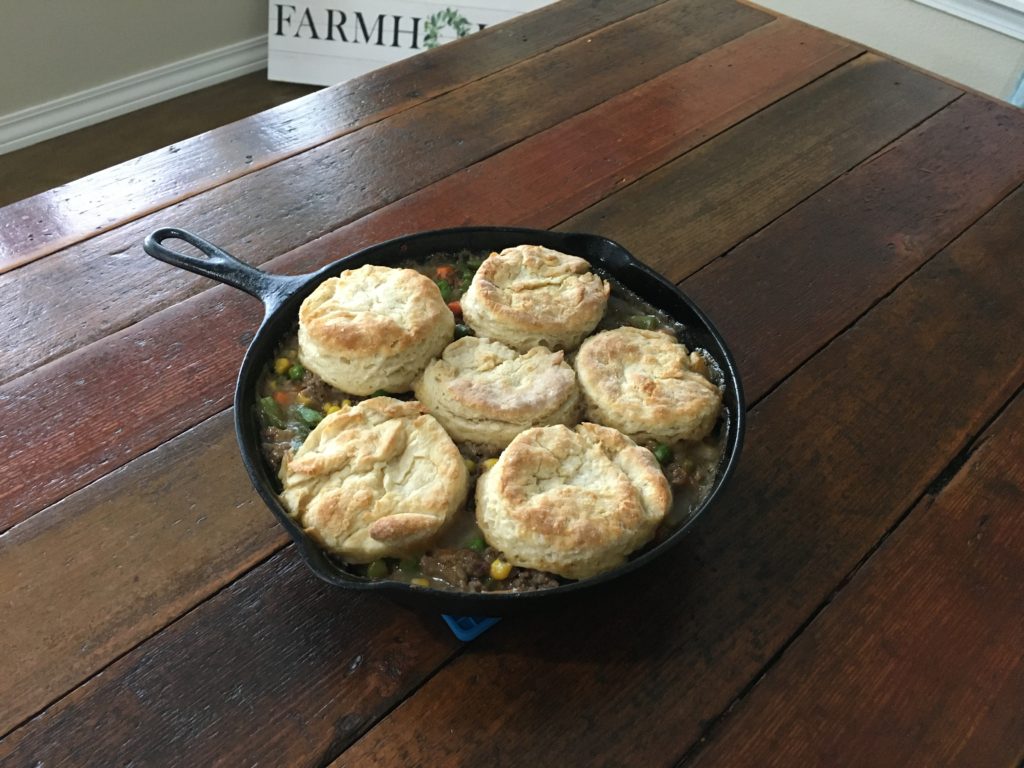
Beef (or Chicken) Pot Pie

I am really loving the chances I have had recently to help a couple of friends with some simple supper ideas and supplies! It’s been super fun to pack their baskets with all the “groceries” they need to make a yummy, super simple, fairly fast, but still wholesome and nourishing dinner for their families. I have sent out two of these baskets for close friends to try. They both had the Beef Alfredo Casserole, that I created from my Nanna’s pantry. I was so excited that both families really loved the food. My first actual “purchased” basket is set to go out tomorrow with the goodies for Smothered Pork Chops!!!! In an effort to share and help more with quick, easy and nourishing family dinners, I am sharing another recipe that our family enjoys regularly!

One of our family’s go-to dinners when I am running late or don’t know what to make is beef or chicken pot pie. This was a pretty simple recipe that I made several times before I felt like I really figured out the broth ratio part of it. The perfect ratio came after making Kansas City Steak Soup a couple times from my Better Homes and Garden Cookbook. This soup is another go-to recipe during colder months for our family and has become the soup we always take to the Vore family Christmas get together (they always do soups and chili). I used the flour and broth combination that is called for in the first part of the recipe and it worked perfectly! Now, in light of complete honesty here, for both the soup and the pot pie (okay, really almost all of my “recipes”) I don’t always totally stick to the plan. I use whatever vegetables I have on hand, and I have been known to use chicken broth with beef pot pie because that’s what I had in the freezer when I needed a quick, nourishing supper. My favorite veggies to “keep on hand” now are the Season’s Choice frozen mixed vegetables from Aldi. We generally buy 1-2 bags each week when we go grocery shopping. Once I had figured our the broth/filling/thickening ratio this recipe became easy to keep throwing together and pleasing our taste buds while nourishing our bodies! However, the last step in making it truly simple came one evening when I just couldn’t bring myself to make a crust for the pot pie. Whenever I make pies or need a crust for cobbler or pot pie, I again turn to my Better Homes and Garden Cookbook and use their single or double pie crust recipe, depending on how much crust I need. Pie crust is one of those things I always dread making, but find surprisingly easy once I get going. Anyway back to the night I just couldn’t get myself motivated to make a pie crust. I did think pot pie sounded good, but I didn’t want to mix, roll and clean up a crust. I did however have some of our favorite biscuits in the freezer. So, I cooked the meat, added the veggies and broth and put the frozen biscuits on top. Then I just set the oven to the 450 degrees needed to bake the biscuits, and baked the whole thing for the 14 minutes that are necessary to cook the biscuits when they’re frozen and a newer, simpler recipe was born! Now, here is that recipe!

Beef/Chicken Pot Pie Recipe:

1 pound ground beef or cut up/shredded chicken (thighs or breasts)

14 ounces beef or chicken broth

1/4 cup flour

1 Bag frozen Mixed veggies (I have used canned before if I don’t have frozen on hand, they just aren’t as crisp)

5-6 Frozen Biscuits (I use this recipe)/or a pie crust

Beef or Chicken Pot Pie Directions:

  1. Brown the meat in a cast iron skillet (any oven safe skillet will work, I just happen to love cast iron)
  2. Preheat the oven to 450 for biscuits and 350 for crust (if using my recipes, otherwise follow the baking directions for the ones you are using)
  3. Whisk flour into broth
  4. Add veggies to the cooked meat
  5. Pour flour/broth mixture over meat and veggies
  6. Stir and cook over medium/high heat until broth just starts to bubble and thicken
  7. Stir a final time to fully combine everything
  8. Salt and pepper to taste
  9. Place frozen biscuits or crust on top of mixture
  10. Bake at 450 for 14 minutes for biscuits, follow the directions for the pie crust recipe that you use. I think I generally bake mine with a pie crust for about 20 minutes at 350 degrees. Your biscuits or crust should be golden brown and your filling bubbling once it’s done.

That’s it, a delicious, filling, one pan dinner! I hope and pray your family enjoys it as much as our family does!! If you make it and love it please be sure to leave a comment below! Also, if you like to experiment with recipes like I do, please share your variations below so we can continue learning and cooking together! What are some of your family’s favorite simple suppers?

Recipes

Biscuit Recipe (amazing fresh or frozen)

These biscuits are my go to for the “crust” of my Beef and Chicken Pot Pies!

I have tried various recipes for biscuits throughout the years. I have been fortunate enough not to have the trouble some people have had with getting biscuits to turn out. But, I have had various levels of success depending on the recipe I use. Some of them turn out really well, but are more complicated than I enjoy. The recipe I am sharing today is a wonderful mix of success and ease. I first tried this recipe from 100 Days of Real Food when I was trying to bake more with whole wheat flour. I try to use more whole wheat flour in order to provide food for my family that is as close to the way God created it as possible. I am continually trying to find ways to serve more whole and minimally processed food to my family. That can be tricky with a husband who was raised on processed food, is very healthy and maintains a healthy weight with no effort (except maybe to gain back weight he’s accidentally lost!!). Because of that and always trying to use what is readily available and on hand, I have used whole wheat, white flour and a mix of the two since starting to use this recipe. I also generally use coconut oil in place of part or all of the butter. I have even used bacon grease before (those were extremely flavorful!!). All of those variations have turned out very well and my family actually eats the whole wheat version as well as the white flour version. I also typically double the batch and put some in the freezer for easy meals later. That is what the picture is of at the top of the post. When I need an easy meal, I can pull out some ground beef, beef broth, frozen veggies, flour and frozen biscuits and have a hearty, filling, flavorful meal on the table in about 30 minutes. Without further ado here is the recipe:

Whole Wheat Biscuits:

2 cups Whole Wheat Flour (I’ve also used White or a combination of the two)

4 tsp Baking Powder

1/2 tsp Salt (I suggest adding extra if you use coconut oil in place of the butter)

4 Tbsp Butter (I have used coconut oil and bacon grease in place of part or all of the butter)

1 cup Milk

Whole Wheat Biscuit Directions:

1. Preheat oven to 450 if baking when you are making them. I often just make them to freeze for later.

2. I whisk all of the dry ingredients together.

3. Add the fat (coconut oil, butter, bacon grease or a combination of those), and I use my hands to mix the fat and dry ingredients together until it is a crumbly mixture.

4. Pour in the milk and use hands to mix it all together until it has almost completely come together.

5. Dump it onto a floured surface and knead just enough to make a finished ball of dough.

6. Either roll or pat the dough out to between a 1/2 to 3/4 inch and use a biscuit cutter, or cookie cutters if the girls are helping, to cut out the biscuits.

7. You are supposed to place them on an ungreased cookie sheet and bake at 450 for 10-12 minutes, if baking immediately after mixing. I have found it helpful at times to go ahead and grease the sheet a bit under the biscuits to limit sticking, but they have never stuck too much regardless of greasing.

If I am freezing some or all of the biscuits to use later I lay them out on plastic wrap and with plastic wrap in between layers to freeze solid. After they have frozen that way, I pull them apart and put them in a freezer bag for longer term storage. I have found that I cannot stack them more than two high for their first freeze, and a single stack is best. If they are stacked more than two high the weight of them still causes them to freeze too tightly together to get apart, even with the plastic wrap between them.

I hope your family enjoys this recipe as much as mine does. My oldest daughter is known to eat several plain biscuits at any point of the day! If your family loves these biscuits please like this post or leave a comment about your experience below! What is your favorite go to freezer meal or food?

EducationHealthParentingRamblings

Essential Minerals are Changing our Lives!

I have heard and read a lot about natural remedies and health options. I was raised taking “sugar pill” homeopathic medicine. They weren’t really sugar pills, they were natural medicine from God’s creation and they really worked. My husband was raised in a family of nurses who are fully trained in western and synthetic medications. I believe both of these things have an important place in our lives and health. I believe that we should always seek natural first, but be willing to consider manmade or synthetic when we need them!

Before, I say anything else. I want be clear about a few things. My husband is very good about wrangling my experimental nature in with the wisdom of the necessity of researching FIRST. I am not a medical expert of ANY kind. I am not recommending ANYTHING for you, I am just sharing what has made such a big difference for myself and my daughter. This information would hopefully empower you to have a conversation with your doctor or to do your own research for things that might help you improve your and your children’s well being!

Since, I love all things natural based, I have experimented a couple of times with making my own toothpaste. One of the ingredients in the recipe I use is Trace Mineral Drops. I ordered the brand recommended on the Weed ’em and Reap website that I got my toothpaste recipe from. So, we use Concentrace Trace Mineral Drops.

Since, I love learning and I love my daughters, they have been one of the things that have propelled me further and further into research on natural remedies for everything from cavities to sleep to focus to reading. Both our girls have had WAY more tooth decay (a.k.a. cavities) than I ever expected. I haven’t had a cavity yet and my husband has only had about 4. So, when our oldest had 7 at the age of 5 I started looking for natural ways to help and that led me to the toothpaste.

This same daughter also struggles with attention and focus and sleep. As, I have done more researching and reading I have read a lot about the importance of magnesium for a huge range of things in our bodies. Some of those are sleep and calm. As I read more and more about this mineral, I remembered the drops we had in the pantry for making toothpaste and I looked to see which minerals they included.

They include magnesium, chloride, sodium, potassium and sulfate, lithium and boron. The highest percentage of all of these? You guessed right! Magnesium. Since, our oldest struggles with sleep she would/will often struggle with getting tired. Tiredness for her would be manifested in extra or hyper energy, crankiness and low to absolutely no emotional control. So, after a lot of discussion AND consulting with their pediatrician, we tried giving some of these drops to the girls. We just wanted to see if they would help with any of the attention or emotional control issues our oldest was having. We gave the drops to both girls just to keep things even, and they are essential minerals so it seemed like they’d benefit anyone.

This particular brand of drops tell you on the bottle that they have a strong flavor and they’re telling the truth! So, we started with mixing a pediatric dose into a lunch box sized cup of apple sauce. It worked perfectly as long as all of the applesauce got eaten. This usually wasn’t an issue unless we forgot about it until a full breakfast had been eaten. Also, occasionally the girls got tired of eating applesauce. What we have currently settled on after trying many things from mixing with honey to diluting in water is to fill a 2 ounce cup with juice (apple juice does not work, grape and a mango mix work the best for us) and adding the drops. We have also increased the amount of drops our oldest takes from the pediatric (ages 1-3) dose to just under 1/2 a dose (she takes between 12-15 drops a day). Everyone seems to be pleased with this method and they are still able to get it down if we forget until after breakfast.

These drops have had a BIG impact on our daughter’s well being. She is better able to regulate her emotions when she has them. These and lavender oil rubbed on her feet or behind her ears also help her sleep better at night. We also use epsom salts in her baths if she seems over tired or extra keyed up. We have tried other magnesium options like gummies, but they do not have the same effect for her. When we were doing the gummies instead of the drops she had a pretty major emotional episode with no real apparent reason. But, when she has the drops those episodes become decidedly less frequent. So, for our family these drops are the only way for us to give her the magnesium she seems to need to balance her emotions, will, and abilities.

Even though the drops were working well for our daughter, I still kept learning and reading as much as I possibly could on more things that would help her or just natural things we might need in order to support our bodies to do the things God calls us to do. One thing that kept coming up when I would read about magnesium was it’s ability to help mom’s with their energy levels, quality of sleep and emotional control (it is said to help alleviate anxiety and possibly depression). So, since it had helped our daughter so much and since I was struggling a LOT with anxiety this past school year (even before Covid-19 hit!!) I decided to try taking the drops myself. We are always trying to stay on a budget and I especially have trouble using extra things that I might not “need” that will end up costing us extra money. That is why I was hesitant to try the drops at first, I wanted them to last as long as possible for the girls. For that reason, the first time I started to take them I would only take half of a dose. And, honestly it seemed to intensify my emotions, so I stopped. Then I was struggling again and reading more and more about how this specific mineral was supposed to help. I also think it was during this time also that I read a post about something Adrienne at Whole New Mom had tried once that didn’t work, but she tried again because it was supposed to and it did. Those things combined together to push me to try the drops again and commit to taking them for a month. I took a full dose every morning and they REALLY started to make a difference. The best way that I can describe it was that it felt like I was lifting my head up out of a heavy fog that I had been living under. It started to feel like there was possibility in life again and I wasn’t sad and overwhelmed all the time.

Recently, we were running low on drops and I hadn’t ordered more yet. So, I stopped taking them to make sure we didn’t run out for the girls. Since our schedules have been rather scattered since March, it took longer than usual to order, and I went awhile without them. I also managed to hurt my shoulder somehow during this time. The pain from my shoulder was going through my back and growing despite my efforts to stretch it out. The essential oils I was putting on my shoulder would help at night, but by the end of the day I was in more and more pain. The new drops came in and I had a day where I just felt awful all day. I skipped my workout in the morning and just dragged, had no energy and more and more pain in my shoulder throughout the day. That night I took a double dose of the drops and went to bed early. My pain was greatly relieved the next day and I felt like my energy was really starting to come back. I have not missed a dose since then. I even got up out of bed one night when I realized I had forgotten to take any that day.

These drops and more specifically, in my OPINION, magnesium have really made a world of difference for our family. In helping both my daughter and I regulate our emotions much better and giving us better rest. I sleep so much heavier and feel like I get much higher quality sleep when I take these drops, especially if I take them at bedtime. I have not switched to taking them at night yet, but I am certainly contemplating it. I wanted to share this with you to give you something to discuss with your doctor or for you to research for yourself if you are struggling with sleep, calm, energy or anxiety. Please do not take my word in deciding to take these drops or anything like them, use wisdom and the professionals in your life to guide your journey! Also, I want to be completely transparent. I still get tired, today in particular has been pretty rough! In addition, our daughter is still her super energetic-anti-sleep-try anything and always has a better and different way of doing things-self. BUT, this mineral must really be as important as I’ve read and these drops have really helped both of us be able to regulate life better. What minerals have you found to be essential to your well being or that of your children? Where do you find reliable information on natural options to optimize health? Please share in the comments below to help us continue learning together!

EducationRamblingsResourcesScience of Reading

Syllable Types, Part 1

According to different programs there are always 6 different syllable types, but there can be as many as 8. The six basic syllable types are Closed Syllables, Open Syllables, Silent e Syllables, R Controlled Vowel Syllables, Vowel Team Syllables and Consonant le or c-le Syllables. Other programs add Diphthong Syllables and Schwa Syllables. Today we will discuss what each of the basic 6 syllable types are and why knowing them is important to helping learners on their reading journey.

First let’s talk about what the syllable types are and what they mean to reading. The syllable types are simply a way of identifying the role of the vowel in each syllable and informs the reader of which vowel sound to use in each syllable. It will tell the reader if the single vowel is long or short. It also tells the reader which of two vowels are sounded if there are multiple vowels in a syllable. The last thing it tells the reader is if the sounded vowel makes a sound that is different from it’s long or short sound as in the case of c-le, r controlled, diphthong and schwa syllables. Now we will talk about what each of the basic 6 syllable types are.

  1. Closed Syllables

The first syllable type children learn to read are closed syllables. This is because the first kind of words children are typically taught are CVC (consonant, vowel, consonant) words. These are the most basic form of closed syllables. A closed syllable is simply a syllable that ends in a consonant. A lot of people remember what a closed syllable is, by remembering that the vowel is closed in by a consonant. This syllable type always uses the short sound for the vowel in the syllable. It is a syllable with a single vowel that is followed by a consonant. Simple examples of this are am, cat, get, and hut. This rule for a closed syllable using a short vowel sound is the reason for some otherwise seemingly extra letters in words like letters. It may seem redundant to have two t’s in the word letters until you realize that the syllable break comes between the two t’s and if there was only one t then it could change the word to having a long e sound and then the pronunciation would change to match the word liters.

To review, a closed syllable is a syllable with one vowel that is followed by one or more consonants. Some more examples are in, kit, snack and the first syllable FIDdle.

2. Open Syllables

The next syllable type children are typically taught is open syllables. They are the opposite of closed syllables. In these syllables the last letter is a vowel. So, these syllables are often remembered as the vowels being open to say their names (long sounds). Remember you can use whatever terms you would like to use to help your individual learner or learners remember these syllable types. But, be careful to call things by their proper names as often as possible (long sound instead of a vowel saying it’s name) to help your learner progress faster and have fewer “new” things to learn. I discuss this idea more thoroughly in my post on Silent e.

3. The third syllable type we will discuss is Silent e Syllables.

Silent e syllables are syllables that have an e at the end of the syllable that make the other vowel in the syllable make it’s long sound as in the words make and hike. One thing that can be kind of tricky for learners when they are syllabicating with Silent e Syllables is that sometimes, when the Silent e syllable comes at the beginning or the middle of the word (when it is not at the end of a word), the e may get dropped. This depends on what comes after the Silent e Syllable. These are still Silent e Syllables even though the e is missing like the middle syllable in misTAKen, or the first syllable in LIKing.

4. R Controlled Syllables

R controlled syllables are syllables that have a vowel follwed directly by an r. Whenever a vowel is followed by an r it makes a different sound than it’s long or short sound or sounds (remember a makes two short sounds, /a/ as in cat and /o/ as in all, and u makes two long sounds /U/ as in cute and /oo/ flute). The trickiest part of r controlled vowels is that three of them make the same sound. This actually simplifies things for reading, but it complicates spelling a bit. er, ir and ur all say /er/ as in fern, bird, and urn. ar and or are easier to remember and distinguish because they generally have their own unique sounds, ar says the sound /are/ and or says the sound of the word it spells /or/. There are sometimes like in the words, word or world, when or says /er/ like er, ir and ur. But, generally, these two r controlled vowels have their own sound. Once your reader has mastered their letter names and sounds it is a good idea to start teaching them the sounds of the digraphs (two letters that come together to make a new sound) wh, ph, sh, th and ch, and the r controlled vowels along with other letter combinations that make specific sounds that are separate from their individual sounds.

5. Vowel Team Syllables

Vowel teams are two vowels that are side by side that follow the rule of, when two vowels go walking the first one does the talking and says it’s name. (Okay, I know, more cutesy stuff, I told you it’s a hard habit to break!!) There are only 6 true vowel teams, although some programs include some diphthongs (letter combinations that include vowels that make a different sound like oi, oy, aw, ow, au, and ou) in their vowel team list. The 6 true vowel teams are ai, ea, ee, ie, and oe. You will find words like said, head, and cutie that bring up either exceptions or other rules for these letter combinations. But these combinations typically follow the rule of the first vowel being long and the second vowel being silent as in mail, sea, see, pie, and toe. So, teaching your reader that these teams make one sound and that sound is the long sound of the first vowel is a reliable reading rule for them to lean on.

6. Consonant le Syllables

Consonant le Syllables are found at the end of words and I have heard them actually called final stable syllables. This syllable type falls into one of those lesser known reasons or rules for a Silent e that I mentioned in that previous post. These syllables actually have a distorted or schwa vowel sound to them. The vowel sound for all of these is a short /oo/ sound. Words like stable, wobble, fiddle, indelible have a consonant le syllable as their final syllable. This syllable type will only be found at the end of multisyllabic words as they cannot stand alone as their own word and they always occur at the end of a word. The only possible exception to these being at the end of a word would be if a suffix has been added after it or it is a compound word like stablehand.

Although, some programs include the two other syllable types of Schwa and Diphthongs and I certainly think they are worth discussing, I will save them for another post. This one covers the 6 basic syllable types and includes a lot of information to digest in one sitting. I also plan to do a post on how to syllabicate or diagram syllables within words to help your reader decode longer and more complex words.

EducationRamblingsResources

Silent e, Rules and Reasons

Silent E: Teaching Kids the Whole Truth - All About Reading

Today we are talking all about silent e. I recently read an email form Children Learning to Read about 5 reasons silent or magic e is used. One of them, I think we all knew, some of the others, I knew, but don’t always or often think about, and some were completely new to me. Since all of these rules will help your child and you learn to become a stronger reader and writer/speller, I thought I would share!

You may notice me using silent e and magic e interchangeably, you may notice the same things with a vowel saying it’s name or long sound. That is because I have had years of teacher training that taught me all these cute sayings to use with young children. I am trying to get away from doing that and using the “grown up” or real terms for things now. But, it is a hard habit to break. I am trying to break it because it causes unnecessary confusion and unnecessary relearning for children. An example of this is that traditionally, children first learn that vowels only make one sound (their short sounds). Then, we teach them that vowels are actually special letters that make two sounds. This is when we tell them that vowels say their names. Later, the child has to learn that those first sounds they learned that vowels make are called short sounds. After that, they learn that vowels names are called their long sounds. Next, they have to learn that a actually has two short sounds and u has two long sounds. Are you exhausted yet!?! Imagine if you were 5 or 6! This progression is not really necessary. I have found that if we expose children to all of their learning from the beginning and only expect mastery of the part that we are focusing on, they learn much more quickly and actually have fewer things to learn. Doing it this way with vowels streamlines things very nicely for learners. Children learn from the beginning that a and u have three sounds, and that e, i and o have two sounds. As they are mastering those sounds we start calling them long and short. Once a child has mastered listing/producing all of the sounds for each of the letters, we can move on to now expecting them to learn and know which are called short and which are called long. This won’t take long because the child has been hearing this information all along. In addition, a child reaches mastery of all the sounds of the letters much more quickly and has more tools to help them read more words more quickly (even before they’ve learned all the rules).

Back to the rules or reasons for using a silent e at the end of words in the English language. We will start with the one that we are all most familiar with:

  1. Use a silent e at the end of a word to make the other vowel in the syllable make it’s long sound.

I say the other vowel in the syllable because this rule is used in single syllable words such as make or site, and multisyllabic words such as awake or antiquate. But, the silent e will always come at the end of the last syllable of the word, and will only affect the other vowel in that syllable. One thing that helps me keep this straight is the fact that a syllable is “a word or a part of a word with one sounded vowel”. So, even though the word make, which is one syllable, has two vowels in it, only the a is a sounded vowel. Therefore, one vowel sound in the word means one syllable in the word.

2. Use a silent e at the end of a word to make c or g say it’s soft sound.

This is another rule or reason for using a silent e that I knew, but don’t always think of. This is why there is a seemingly irrelevant e at the end of words like manage or essence. When we think of silent e’s as only having the role of the first rule, then these words do not seem to follow the rules and become some of a seemingly unending pile of exceptions in our language. BUT, when we remember the rule that a c or a g followed by an e, i or y makes it’s soft sound, then all of a sudden these “extra” e’s serve a purpose and make sense for the accurate pronunciation and spelling of these words!

This is where my knowledge of silent e’s rules and roles stopped. But the article I read from Children Learning to Read shared 3 more!

3. Use silent e to change the spelling of homophones.

Homophones are words that sound the same, but have different meanings like pair, pare and pear or bear and bare. These are the homophones I have seen and thought of the most. But there are other homophones that includes plural forms of one word and a totally different word that sounds just like the plural. These are words such as pleas (plural of a plea) and please (to make someone happy). Or another and humorous example is moos (two sounds from a cow) and moose (a large four legged animal).

4. Use a silent e because English words do not end in u or v.

This is one, I recognized once I read it and saw examples, but I did NOT know as a rule for our language! Now those rule breaking exceptions of have and give, just aren’t. I know you may be wondering, like I do, why can’t our words end in u or v, and I don’t know! But, as a child who is learning to write and spell, if I know that English words can’t and that when there a u or v as the last sound I hear in a word, I add an e, I’ll spell so many more words correctly like true and blue. AND, they won’t seem like more words in an ever mounting pile of rule breakers! I am a rule follower by nature, but I’m pretty sure even if I wasn’t, I would find these rules comforting! This is because they are like a road map, and the more of them I know the more detailed the map becomes and the easier it is to find my way! On to our last rule!

5. Every syllable has to have a vowel.

I never really thought of this one because the first thing I learned in regards to this (as a teacher, I didn’t learn anything about syllable types or this rule as a child) was the final stable syllable type of consonant le, like –cle, –dle, –fle, etc. These became syllables for me because they had a vowel sound, and I was taught to have my students circle them when we were syllabicating (diagraming the syllables in words). But, I do know, as mentioned earlier, that every syllable has to have a vowel sound. This just takes it one step further and says that it not only has to have the vowel sound, but an actual written vowel. So, even if the e doesn’t make it’s own short or long vowel sound, it is written here to represent the vowel sound in these syllables in words like stable, little, and bottle.

I hope these 5 rules help you gain a better understanding of the reading and spelling rules that really do govern our language. I hope and pray that they help you reduce your pile of exceptions. And, I hope and pray you get to share this knowledge with someone to make their reading and writing journey easier!

Did you know all of these rules? Do you know any more or different rules about silent e? What has been your most astonishing rule to learn about the English language? Please share so we can continue to learn together!

EducationFaithRamblings

Progress not Perfection!

Strive for progress, not perfection. | Lovesvg.com

This is a quote that is quickly becoming a mantra of mine. The strangest thing about that is that I don’t really even like this quote. Now, I think this is marvelous quote for others to live by and I fully support them in their journeys and think this is an excellent way to be! I am so proud of their progress and learning and ability to focus on and celebrate their growth and want to celebrate with them! But, for myself, I find it HARD to do this! I am a perfectionist and if I spend all of my time celebrating baby steps won’t I just become complacent and never reach perfection?

However, as I encounter some version of this idea in seemingly every area of my life, I am adjusting to becoming open to learning from this! I have truly seen this quote or some version of it almost everywhere. I have seen and read it from Kelsey at Hiitburn and I have seen it in Kevin Hart’s posts (who I started following at @kevinhart4real on Instagram in an effort to learn more about the systemic racism we continue to deal with in our nation (he was not using it in reference to racial issues, I believe it was in reference to his own fitness journey). I have seen a version of it from Ruth Soukup from Living Well Spending Less, and from Alida Quittschreiber at The Realistic Mama. I have even seen it in the Bible in Philippians 3: 12 when Paul says he has not yet attained perfection, but he presses on that he may lay hold of what Christ has laid hold of for him.

When I find something again and again and from some many sources I think it deserves my attention. When I see it in scripture I know it is true. I am trying to listen and to understand it more since I have seen it in all these places! Especially since I have seen it in the one place that truly counts, the Bible!

Here are some things I am taking away from this quote.

1 ~ It can mean starting again after you mess up because it is still progress if you learn something.

2 ~ It can mean taking just the next step in front of you whether it is big or small and not worrying about the whole or big picture when you’re overwhelmed.

3 ~ It can mean being kind to yourself when a baby step is all you can take.

4 ~ It means that a baby step in the right direction is better than doing nothing at all or heading in the wrong direction.

5 ~ It can mean adding things to your healthy eating or workout routine INSTEAD of taking things away.

6 ~ It can mean that a TRUE 80/20 rule really does make a positive impact.

7 ~ It means that slow and sustainable is better than fast and too rigid for long term growth and well being.

Since this quote can be seen in the God inspired Word of Him, I must have something to learn from it. And I am slowly learning that my best IS good enough. I am learning that I don’t have to know all the answers or get it ALL right ALL of the time. I am also seeing that my perfectionism is rooted in a false belief that I can get it ALL right ALL of the time on my own if I’ll just try harder or give up more or be better. The reality is I am frail, incapable and completely fallible on my own. Anything I get right or excel at is because of Jesus working in me to make me more like Him. As I keep my eyes on Him and allow Him to do His work in and through me, I will make progress toward perfection. Unfortunately, I must also realize, as it says in the Bible, that I will continue to war with my “old man” (my sin nature) until heaven. That means mess ups, failures, and falling short. My perfectionist nature HATES this. But if I can accept my frailty and lean on and learn from Christ more because of it, He will help me clean up my messes, learn from my failures and reach beyond my limitations in His strength. So, I will strive for perfection through progress. I will keep my eyes on Jesus and “the joy set before” me. I will strive to take up my cross daily and when the road is a slippery, sloppy mess instead of a straight clear path forward, I will repent, ACCEPT His grace and forgiveness and keep moving forward, “not having attained it… but striving toward” Him!

What are your thoughts on this quote? Is it a comfort or a thorn? Have you seen it work in your own life? Please share so we can learn from each other and move forward together!

FaithParentingRamblings

Mary, Martha and two baby girls

If you are like me you have heard of the two sisters in the Bible named Mary and Martha. Martha is the hardworking, behind the scenes one who gets all flustered when a bunch of people come to dinner and she feels like she can’t keep up. Mary is the one whose focus remains on Jesus no matter what is going on around her. I’ve heard multiple sermons and lessons on these two ladies and the virtues of both. The trouble I have is that I relate mostly to Martha and wish mostly to be Mary. I’ve always aspired to be a Mary while most of the time remaining a Martha. I have family and friends that are more Maryish than I am and I look up to them.

Now, let me be very clear. I know that Mary minded people are hard workers and get a lot of things done. They are people I lookup to and aspire to become more like. This is because they keep their eyes and focus on Jesus and therefore become more like Him and reflect Him all the more brightly. I tend to be more of a Martha, though. Getting distracted by the things that need to be done and trying desperately to keep up, more often describes me, than someone able to block all that out find and maintain a quiet and attentive relationship with Jesus.

The thing I am starting to realize though, is that although I do have more Martha tendencies, I am able to have attributes of both of them at different times. I may aspire to be a Mary, but Jesus loved Martha just as much as He loved Mary. That means that there are valuable things to be learned from both of them. They were both cherished friends of Christ. They both had a special and deep friendship with Him. It is reassuring to me to know that even though I may get distracted and activity focused instead of Jesus and people focused, I can have a deep and growing friendship with Christ.

As I recognize that even if I am a Martha, I can have Mary moments, I recognize that the things that make us unique are what make us valued. We should not seek to become like someone else (except Jesus), we should seek to be the very best version of ourselves. God made no mistakes when he made us. Each of us is a cherished treasure to him and have things unique to ourselves, temperaments and personalities. We must work to keep our eyes on Him and aspire to become more like Him. In doing that, we will bring the best version of ourselves and the gifts He has given us to help the world and love Him more.

This recognition also helps me treasure and value my daughters. They are just about as opposite as possible. Even to the point that until very recently, when we would have Chili Dogs on Wednesdays at church, one would eat just chili and the other would eat just a hotdog. The girls are very different and have their own unique gifts and treasures to add to our family and all of their relationships. I must make time each day to recognize their gifts and strengths. I must help them to recognize their strengths and teach them how to use them to enrich and bless the lives of those around them. As I treasure them and their uniqueness, I pray that they will recognize their own talents and fall more deeply in love with the God who gave those gifts to them. I pray that if I treasure their gifts and uniqueness it will also teach them to treasure the unique gifts of all those they encounter.

As we recognize the gifted uniqueness God has put into ourselves, we can see that gift in others. If we struggle to see it in ourselves we will likely struggle to see it in others. But, if it is easier for you to recognize the unique giftedness of others than yourself, take heart! Because whether you start with the foundation of your own unique gifts or those of other people, you have to even out the equation so to speak. Just as a math equation has to be balanced on both sides, if God has placed blessed uniqueness in others it must be in you AND visa versa. This has to be true because God created all of us! The only thing that can distort this giftedness is lacking Christ. Once He enters our hearts He lights up the mosaic of the gifts He’s placed within us.

Have you trusted Him with your life and the gifts He’s given you? What unique gifts have you seen Him use either from yourself to others or from others to yourself?