Sharing Rambling, Resources and Recipes for Learning in Life

Sharing Rambling, Resources and Recipes for Learning in Life

Category: Ramblings

EducationFaithParentingRamblings

School This Fall

First Day of School!

This is my absolute favorite first day of school picture!! Whitley was headed to First Grade, Brinley to Pre-K, and Adam to his second year in our hometown district. We were all at school (at least the same district) together! It was one of those perfect moments that you cherish and want to freeze in time. In a lot of ways I still wish it would have frozen. If it had frozen I wouldn’t be faced with all the churning emotions I am facing now! This day was the beginning of a dream come true for our family. Adam was finally a full time coach, I was working in Title I which was more aligned with my strengths in data analysis, remediation and coaching and both girls were blissfully headed to a new beginnings at the elementary school I went to and in the district both Adam and I graduated from!

However, nothing about that moment did freeze. The girls are older and facing new dimensions in their education that have me constantly working to stay ahead of them in knowing how best to teach them and help them grow. I am also constantly wondering and evaluating what kind of an education would best meet their needs and help magnify their strengths while strengthening their weaknesses. Adam has stepped away from coaching due to some differences in his faith and feelings and the direction some parts of the athletic department were going. I am now back in the classroom in the Middle School teaching remedial reading. All of these things, topped off with home and virtual schooling through the Corona Virus last spring and the uncertainties of what school will be like in the fall, have made our upcoming return a source of continued angst for me.

I loved the chance to be at home and be the girls’ teacher. There were certainly difficult days as they adjusted to my expectations and I adjusted to their needs. All that while working with my own students online. No matter how difficult the day was, I still loved the chance to be there with them. And they benefited from the chance to have that small group or individual instruction tailored to their needs. As always I want to take EVERY opportunity to recognize the AMAZING teachers my daughters have had and the TREMENDOUS heart and impact they have given and had on the girls. I will never be able to thank them for all that they have and continue to do for the girls. However, my momma’s heart tugs at me every time I think of another year of spending so little time with them and giving up the chance to help them individually and give them such specialized and strategic teaching as can only be afforded in such a low teacher/student ratio.

On top of those concerns, we have the uncertainty of what school will even look like in the fall. Will we all have to wear masks? Will the girls have school every day? Will I be teaching students in the classroom or on the computer or both. Our district is getting a new superintendent for the 2020-2021 school year. And, although, I am ecstatic about this addition to our district, she doesn’t start until July 1st and that means planning for the fall is going much slower than I would like it to. As of today I only have 6 weeks until I return to school for in-service, but I have no idea what school will look like for myself or my daughters when they return in 7 weeks.

In addition to this Adam is contemplating a return to coaching and has made some soft steps in that direction, while still pursuing some other out-of-education options. However, as with our plan for school in the fall, none of that is nailed down for him either. He was on the brink of a job offer the week our state closed down for Covid-19. That job offer still stands tentatively depending on the continued upswing of the company as we start to emerge from shut down.

All of this uncertainty and a longing to be a greater part of my daughters’ lives, education and faith have left me anxious and, quite honestly, full of dread for the upcoming start of school. BUT, God is sovereign, good and LOVE. He loves my daughters more than I do and He has a plan for our family even if we don’t know what it is or if it doesn’t seem to be one we want. So, day after day, I choose to praise Him and leave my cares at His feet. I have to do it day by day and honestly sometimes minute by minute. He is faithful, but my faith is wavering. Yet, I press on towards the upward call of Christ Jesus. I strive to remember all of this is fleeting and temporary and He will give me enough time in those fleeting moments with my babies. He will establish us in Him and that is an establishment that cannot be shaken or overcome.

These are the struggles I am facing today. What are you trusting God to be working out on your behalf? Please share so I can pray for you and your journey of faith!

EducationHealthParentingRamblings

Essential Minerals are Changing our Lives!

I have heard and read a lot about natural remedies and health options. I was raised taking “sugar pill” homeopathic medicine. They weren’t really sugar pills, they were natural medicine from God’s creation and they really worked. My husband was raised in a family of nurses who are fully trained in western and synthetic medications. I believe both of these things have an important place in our lives and health. I believe that we should always seek natural first, but be willing to consider manmade or synthetic when we need them!

Before, I say anything else. I want be clear about a few things. My husband is very good about wrangling my experimental nature in with the wisdom of the necessity of researching FIRST. I am not a medical expert of ANY kind. I am not recommending ANYTHING for you, I am just sharing what has made such a big difference for myself and my daughter. This information would hopefully empower you to have a conversation with your doctor or to do your own research for things that might help you improve your and your children’s well being!

Since, I love all things natural based, I have experimented a couple of times with making my own toothpaste. One of the ingredients in the recipe I use is Trace Mineral Drops. I ordered the brand recommended on the Weed ’em and Reap website that I got my toothpaste recipe from. So, we use Concentrace Trace Mineral Drops.

Since, I love learning and I love my daughters, they have been one of the things that have propelled me further and further into research on natural remedies for everything from cavities to sleep to focus to reading. Both our girls have had WAY more tooth decay (a.k.a. cavities) than I ever expected. I haven’t had a cavity yet and my husband has only had about 4. So, when our oldest had 7 at the age of 5 I started looking for natural ways to help and that led me to the toothpaste.

This same daughter also struggles with attention and focus and sleep. As, I have done more researching and reading I have read a lot about the importance of magnesium for a huge range of things in our bodies. Some of those are sleep and calm. As I read more and more about this mineral, I remembered the drops we had in the pantry for making toothpaste and I looked to see which minerals they included.

They include magnesium, chloride, sodium, potassium and sulfate, lithium and boron. The highest percentage of all of these? You guessed right! Magnesium. Since, our oldest struggles with sleep she would/will often struggle with getting tired. Tiredness for her would be manifested in extra or hyper energy, crankiness and low to absolutely no emotional control. So, after a lot of discussion AND consulting with their pediatrician, we tried giving some of these drops to the girls. We just wanted to see if they would help with any of the attention or emotional control issues our oldest was having. We gave the drops to both girls just to keep things even, and they are essential minerals so it seemed like they’d benefit anyone.

This particular brand of drops tell you on the bottle that they have a strong flavor and they’re telling the truth! So, we started with mixing a pediatric dose into a lunch box sized cup of apple sauce. It worked perfectly as long as all of the applesauce got eaten. This usually wasn’t an issue unless we forgot about it until a full breakfast had been eaten. Also, occasionally the girls got tired of eating applesauce. What we have currently settled on after trying many things from mixing with honey to diluting in water is to fill a 2 ounce cup with juice (apple juice does not work, grape and a mango mix work the best for us) and adding the drops. We have also increased the amount of drops our oldest takes from the pediatric (ages 1-3) dose to just under 1/2 a dose (she takes between 12-15 drops a day). Everyone seems to be pleased with this method and they are still able to get it down if we forget until after breakfast.

These drops have had a BIG impact on our daughter’s well being. She is better able to regulate her emotions when she has them. These and lavender oil rubbed on her feet or behind her ears also help her sleep better at night. We also use epsom salts in her baths if she seems over tired or extra keyed up. We have tried other magnesium options like gummies, but they do not have the same effect for her. When we were doing the gummies instead of the drops she had a pretty major emotional episode with no real apparent reason. But, when she has the drops those episodes become decidedly less frequent. So, for our family these drops are the only way for us to give her the magnesium she seems to need to balance her emotions, will, and abilities.

Even though the drops were working well for our daughter, I still kept learning and reading as much as I possibly could on more things that would help her or just natural things we might need in order to support our bodies to do the things God calls us to do. One thing that kept coming up when I would read about magnesium was it’s ability to help mom’s with their energy levels, quality of sleep and emotional control (it is said to help alleviate anxiety and possibly depression). So, since it had helped our daughter so much and since I was struggling a LOT with anxiety this past school year (even before Covid-19 hit!!) I decided to try taking the drops myself. We are always trying to stay on a budget and I especially have trouble using extra things that I might not “need” that will end up costing us extra money. That is why I was hesitant to try the drops at first, I wanted them to last as long as possible for the girls. For that reason, the first time I started to take them I would only take half of a dose. And, honestly it seemed to intensify my emotions, so I stopped. Then I was struggling again and reading more and more about how this specific mineral was supposed to help. I also think it was during this time also that I read a post about something Adrienne at Whole New Mom had tried once that didn’t work, but she tried again because it was supposed to and it did. Those things combined together to push me to try the drops again and commit to taking them for a month. I took a full dose every morning and they REALLY started to make a difference. The best way that I can describe it was that it felt like I was lifting my head up out of a heavy fog that I had been living under. It started to feel like there was possibility in life again and I wasn’t sad and overwhelmed all the time.

Recently, we were running low on drops and I hadn’t ordered more yet. So, I stopped taking them to make sure we didn’t run out for the girls. Since our schedules have been rather scattered since March, it took longer than usual to order, and I went awhile without them. I also managed to hurt my shoulder somehow during this time. The pain from my shoulder was going through my back and growing despite my efforts to stretch it out. The essential oils I was putting on my shoulder would help at night, but by the end of the day I was in more and more pain. The new drops came in and I had a day where I just felt awful all day. I skipped my workout in the morning and just dragged, had no energy and more and more pain in my shoulder throughout the day. That night I took a double dose of the drops and went to bed early. My pain was greatly relieved the next day and I felt like my energy was really starting to come back. I have not missed a dose since then. I even got up out of bed one night when I realized I had forgotten to take any that day.

These drops and more specifically, in my OPINION, magnesium have really made a world of difference for our family. In helping both my daughter and I regulate our emotions much better and giving us better rest. I sleep so much heavier and feel like I get much higher quality sleep when I take these drops, especially if I take them at bedtime. I have not switched to taking them at night yet, but I am certainly contemplating it. I wanted to share this with you to give you something to discuss with your doctor or for you to research for yourself if you are struggling with sleep, calm, energy or anxiety. Please do not take my word in deciding to take these drops or anything like them, use wisdom and the professionals in your life to guide your journey! Also, I want to be completely transparent. I still get tired, today in particular has been pretty rough! In addition, our daughter is still her super energetic-anti-sleep-try anything and always has a better and different way of doing things-self. BUT, this mineral must really be as important as I’ve read and these drops have really helped both of us be able to regulate life better. What minerals have you found to be essential to your well being or that of your children? Where do you find reliable information on natural options to optimize health? Please share in the comments below to help us continue learning together!

EducationRamblingsResourcesScience of Reading

Syllable Types, Part 1

According to different programs there are always 6 different syllable types, but there can be as many as 8. The six basic syllable types are Closed Syllables, Open Syllables, Silent e Syllables, R Controlled Vowel Syllables, Vowel Team Syllables and Consonant le or c-le Syllables. Other programs add Diphthong Syllables and Schwa Syllables. Today we will discuss what each of the basic 6 syllable types are and why knowing them is important to helping learners on their reading journey.

First let’s talk about what the syllable types are and what they mean to reading. The syllable types are simply a way of identifying the role of the vowel in each syllable and informs the reader of which vowel sound to use in each syllable. It will tell the reader if the single vowel is long or short. It also tells the reader which of two vowels are sounded if there are multiple vowels in a syllable. The last thing it tells the reader is if the sounded vowel makes a sound that is different from it’s long or short sound as in the case of c-le, r controlled, diphthong and schwa syllables. Now we will talk about what each of the basic 6 syllable types are.

  1. Closed Syllables

The first syllable type children learn to read are closed syllables. This is because the first kind of words children are typically taught are CVC (consonant, vowel, consonant) words. These are the most basic form of closed syllables. A closed syllable is simply a syllable that ends in a consonant. A lot of people remember what a closed syllable is, by remembering that the vowel is closed in by a consonant. This syllable type always uses the short sound for the vowel in the syllable. It is a syllable with a single vowel that is followed by a consonant. Simple examples of this are am, cat, get, and hut. This rule for a closed syllable using a short vowel sound is the reason for some otherwise seemingly extra letters in words like letters. It may seem redundant to have two t’s in the word letters until you realize that the syllable break comes between the two t’s and if there was only one t then it could change the word to having a long e sound and then the pronunciation would change to match the word liters.

To review, a closed syllable is a syllable with one vowel that is followed by one or more consonants. Some more examples are in, kit, snack and the first syllable FIDdle.

2. Open Syllables

The next syllable type children are typically taught is open syllables. They are the opposite of closed syllables. In these syllables the last letter is a vowel. So, these syllables are often remembered as the vowels being open to say their names (long sounds). Remember you can use whatever terms you would like to use to help your individual learner or learners remember these syllable types. But, be careful to call things by their proper names as often as possible (long sound instead of a vowel saying it’s name) to help your learner progress faster and have fewer “new” things to learn. I discuss this idea more thoroughly in my post on Silent e.

3. The third syllable type we will discuss is Silent e Syllables.

Silent e syllables are syllables that have an e at the end of the syllable that make the other vowel in the syllable make it’s long sound as in the words make and hike. One thing that can be kind of tricky for learners when they are syllabicating with Silent e Syllables is that sometimes, when the Silent e syllable comes at the beginning or the middle of the word (when it is not at the end of a word), the e may get dropped. This depends on what comes after the Silent e Syllable. These are still Silent e Syllables even though the e is missing like the middle syllable in misTAKen, or the first syllable in LIKing.

4. R Controlled Syllables

R controlled syllables are syllables that have a vowel follwed directly by an r. Whenever a vowel is followed by an r it makes a different sound than it’s long or short sound or sounds (remember a makes two short sounds, /a/ as in cat and /o/ as in all, and u makes two long sounds /U/ as in cute and /oo/ flute). The trickiest part of r controlled vowels is that three of them make the same sound. This actually simplifies things for reading, but it complicates spelling a bit. er, ir and ur all say /er/ as in fern, bird, and urn. ar and or are easier to remember and distinguish because they generally have their own unique sounds, ar says the sound /are/ and or says the sound of the word it spells /or/. There are sometimes like in the words, word or world, when or says /er/ like er, ir and ur. But, generally, these two r controlled vowels have their own sound. Once your reader has mastered their letter names and sounds it is a good idea to start teaching them the sounds of the digraphs (two letters that come together to make a new sound) wh, ph, sh, th and ch, and the r controlled vowels along with other letter combinations that make specific sounds that are separate from their individual sounds.

5. Vowel Team Syllables

Vowel teams are two vowels that are side by side that follow the rule of, when two vowels go walking the first one does the talking and says it’s name. (Okay, I know, more cutesy stuff, I told you it’s a hard habit to break!!) There are only 6 true vowel teams, although some programs include some diphthongs (letter combinations that include vowels that make a different sound like oi, oy, aw, ow, au, and ou) in their vowel team list. The 6 true vowel teams are ai, ea, ee, ie, and oe. You will find words like said, head, and cutie that bring up either exceptions or other rules for these letter combinations. But these combinations typically follow the rule of the first vowel being long and the second vowel being silent as in mail, sea, see, pie, and toe. So, teaching your reader that these teams make one sound and that sound is the long sound of the first vowel is a reliable reading rule for them to lean on.

6. Consonant le Syllables

Consonant le Syllables are found at the end of words and I have heard them actually called final stable syllables. This syllable type falls into one of those lesser known reasons or rules for a Silent e that I mentioned in that previous post. These syllables actually have a distorted or schwa vowel sound to them. The vowel sound for all of these is a short /oo/ sound. Words like stable, wobble, fiddle, indelible have a consonant le syllable as their final syllable. This syllable type will only be found at the end of multisyllabic words as they cannot stand alone as their own word and they always occur at the end of a word. The only possible exception to these being at the end of a word would be if a suffix has been added after it or it is a compound word like stablehand.

Although, some programs include the two other syllable types of Schwa and Diphthongs and I certainly think they are worth discussing, I will save them for another post. This one covers the 6 basic syllable types and includes a lot of information to digest in one sitting. I also plan to do a post on how to syllabicate or diagram syllables within words to help your reader decode longer and more complex words.

EducationRamblingsResources

Silent e, Rules and Reasons

Silent E: Teaching Kids the Whole Truth - All About Reading

Today we are talking all about silent e. I recently read an email form Children Learning to Read about 5 reasons silent or magic e is used. One of them, I think we all knew, some of the others, I knew, but don’t always or often think about, and some were completely new to me. Since all of these rules will help your child and you learn to become a stronger reader and writer/speller, I thought I would share!

You may notice me using silent e and magic e interchangeably, you may notice the same things with a vowel saying it’s name or long sound. That is because I have had years of teacher training that taught me all these cute sayings to use with young children. I am trying to get away from doing that and using the “grown up” or real terms for things now. But, it is a hard habit to break. I am trying to break it because it causes unnecessary confusion and unnecessary relearning for children. An example of this is that traditionally, children first learn that vowels only make one sound (their short sounds). Then, we teach them that vowels are actually special letters that make two sounds. This is when we tell them that vowels say their names. Later, the child has to learn that those first sounds they learned that vowels make are called short sounds. After that, they learn that vowels names are called their long sounds. Next, they have to learn that a actually has two short sounds and u has two long sounds. Are you exhausted yet!?! Imagine if you were 5 or 6! This progression is not really necessary. I have found that if we expose children to all of their learning from the beginning and only expect mastery of the part that we are focusing on, they learn much more quickly and actually have fewer things to learn. Doing it this way with vowels streamlines things very nicely for learners. Children learn from the beginning that a and u have three sounds, and that e, i and o have two sounds. As they are mastering those sounds we start calling them long and short. Once a child has mastered listing/producing all of the sounds for each of the letters, we can move on to now expecting them to learn and know which are called short and which are called long. This won’t take long because the child has been hearing this information all along. In addition, a child reaches mastery of all the sounds of the letters much more quickly and has more tools to help them read more words more quickly (even before they’ve learned all the rules).

Back to the rules or reasons for using a silent e at the end of words in the English language. We will start with the one that we are all most familiar with:

  1. Use a silent e at the end of a word to make the other vowel in the syllable make it’s long sound.

I say the other vowel in the syllable because this rule is used in single syllable words such as make or site, and multisyllabic words such as awake or antiquate. But, the silent e will always come at the end of the last syllable of the word, and will only affect the other vowel in that syllable. One thing that helps me keep this straight is the fact that a syllable is “a word or a part of a word with one sounded vowel”. So, even though the word make, which is one syllable, has two vowels in it, only the a is a sounded vowel. Therefore, one vowel sound in the word means one syllable in the word.

2. Use a silent e at the end of a word to make c or g say it’s soft sound.

This is another rule or reason for using a silent e that I knew, but don’t always think of. This is why there is a seemingly irrelevant e at the end of words like manage or essence. When we think of silent e’s as only having the role of the first rule, then these words do not seem to follow the rules and become some of a seemingly unending pile of exceptions in our language. BUT, when we remember the rule that a c or a g followed by an e, i or y makes it’s soft sound, then all of a sudden these “extra” e’s serve a purpose and make sense for the accurate pronunciation and spelling of these words!

This is where my knowledge of silent e’s rules and roles stopped. But the article I read from Children Learning to Read shared 3 more!

3. Use silent e to change the spelling of homophones.

Homophones are words that sound the same, but have different meanings like pair, pare and pear or bear and bare. These are the homophones I have seen and thought of the most. But there are other homophones that includes plural forms of one word and a totally different word that sounds just like the plural. These are words such as pleas (plural of a plea) and please (to make someone happy). Or another and humorous example is moos (two sounds from a cow) and moose (a large four legged animal).

4. Use a silent e because English words do not end in u or v.

This is one, I recognized once I read it and saw examples, but I did NOT know as a rule for our language! Now those rule breaking exceptions of have and give, just aren’t. I know you may be wondering, like I do, why can’t our words end in u or v, and I don’t know! But, as a child who is learning to write and spell, if I know that English words can’t and that when there a u or v as the last sound I hear in a word, I add an e, I’ll spell so many more words correctly like true and blue. AND, they won’t seem like more words in an ever mounting pile of rule breakers! I am a rule follower by nature, but I’m pretty sure even if I wasn’t, I would find these rules comforting! This is because they are like a road map, and the more of them I know the more detailed the map becomes and the easier it is to find my way! On to our last rule!

5. Every syllable has to have a vowel.

I never really thought of this one because the first thing I learned in regards to this (as a teacher, I didn’t learn anything about syllable types or this rule as a child) was the final stable syllable type of consonant le, like –cle, –dle, –fle, etc. These became syllables for me because they had a vowel sound, and I was taught to have my students circle them when we were syllabicating (diagraming the syllables in words). But, I do know, as mentioned earlier, that every syllable has to have a vowel sound. This just takes it one step further and says that it not only has to have the vowel sound, but an actual written vowel. So, even if the e doesn’t make it’s own short or long vowel sound, it is written here to represent the vowel sound in these syllables in words like stable, little, and bottle.

I hope these 5 rules help you gain a better understanding of the reading and spelling rules that really do govern our language. I hope and pray that they help you reduce your pile of exceptions. And, I hope and pray you get to share this knowledge with someone to make their reading and writing journey easier!

Did you know all of these rules? Do you know any more or different rules about silent e? What has been your most astonishing rule to learn about the English language? Please share so we can continue to learn together!

EducationFaithRamblings

Progress not Perfection!

Strive for progress, not perfection. | Lovesvg.com

This is a quote that is quickly becoming a mantra of mine. The strangest thing about that is that I don’t really even like this quote. Now, I think this is marvelous quote for others to live by and I fully support them in their journeys and think this is an excellent way to be! I am so proud of their progress and learning and ability to focus on and celebrate their growth and want to celebrate with them! But, for myself, I find it HARD to do this! I am a perfectionist and if I spend all of my time celebrating baby steps won’t I just become complacent and never reach perfection?

However, as I encounter some version of this idea in seemingly every area of my life, I am adjusting to becoming open to learning from this! I have truly seen this quote or some version of it almost everywhere. I have seen and read it from Kelsey at Hiitburn and I have seen it in Kevin Hart’s posts (who I started following at @kevinhart4real on Instagram in an effort to learn more about the systemic racism we continue to deal with in our nation (he was not using it in reference to racial issues, I believe it was in reference to his own fitness journey). I have seen a version of it from Ruth Soukup from Living Well Spending Less, and from Alida Quittschreiber at The Realistic Mama. I have even seen it in the Bible in Philippians 3: 12 when Paul says he has not yet attained perfection, but he presses on that he may lay hold of what Christ has laid hold of for him.

When I find something again and again and from some many sources I think it deserves my attention. When I see it in scripture I know it is true. I am trying to listen and to understand it more since I have seen it in all these places! Especially since I have seen it in the one place that truly counts, the Bible!

Here are some things I am taking away from this quote.

1 ~ It can mean starting again after you mess up because it is still progress if you learn something.

2 ~ It can mean taking just the next step in front of you whether it is big or small and not worrying about the whole or big picture when you’re overwhelmed.

3 ~ It can mean being kind to yourself when a baby step is all you can take.

4 ~ It means that a baby step in the right direction is better than doing nothing at all or heading in the wrong direction.

5 ~ It can mean adding things to your healthy eating or workout routine INSTEAD of taking things away.

6 ~ It can mean that a TRUE 80/20 rule really does make a positive impact.

7 ~ It means that slow and sustainable is better than fast and too rigid for long term growth and well being.

Since this quote can be seen in the God inspired Word of Him, I must have something to learn from it. And I am slowly learning that my best IS good enough. I am learning that I don’t have to know all the answers or get it ALL right ALL of the time. I am also seeing that my perfectionism is rooted in a false belief that I can get it ALL right ALL of the time on my own if I’ll just try harder or give up more or be better. The reality is I am frail, incapable and completely fallible on my own. Anything I get right or excel at is because of Jesus working in me to make me more like Him. As I keep my eyes on Him and allow Him to do His work in and through me, I will make progress toward perfection. Unfortunately, I must also realize, as it says in the Bible, that I will continue to war with my “old man” (my sin nature) until heaven. That means mess ups, failures, and falling short. My perfectionist nature HATES this. But if I can accept my frailty and lean on and learn from Christ more because of it, He will help me clean up my messes, learn from my failures and reach beyond my limitations in His strength. So, I will strive for perfection through progress. I will keep my eyes on Jesus and “the joy set before” me. I will strive to take up my cross daily and when the road is a slippery, sloppy mess instead of a straight clear path forward, I will repent, ACCEPT His grace and forgiveness and keep moving forward, “not having attained it… but striving toward” Him!

What are your thoughts on this quote? Is it a comfort or a thorn? Have you seen it work in your own life? Please share so we can learn from each other and move forward together!

FaithParentingRamblings

Mary, Martha and two baby girls

If you are like me you have heard of the two sisters in the Bible named Mary and Martha. Martha is the hardworking, behind the scenes one who gets all flustered when a bunch of people come to dinner and she feels like she can’t keep up. Mary is the one whose focus remains on Jesus no matter what is going on around her. I’ve heard multiple sermons and lessons on these two ladies and the virtues of both. The trouble I have is that I relate mostly to Martha and wish mostly to be Mary. I’ve always aspired to be a Mary while most of the time remaining a Martha. I have family and friends that are more Maryish than I am and I look up to them.

Now, let me be very clear. I know that Mary minded people are hard workers and get a lot of things done. They are people I lookup to and aspire to become more like. This is because they keep their eyes and focus on Jesus and therefore become more like Him and reflect Him all the more brightly. I tend to be more of a Martha, though. Getting distracted by the things that need to be done and trying desperately to keep up, more often describes me, than someone able to block all that out find and maintain a quiet and attentive relationship with Jesus.

The thing I am starting to realize though, is that although I do have more Martha tendencies, I am able to have attributes of both of them at different times. I may aspire to be a Mary, but Jesus loved Martha just as much as He loved Mary. That means that there are valuable things to be learned from both of them. They were both cherished friends of Christ. They both had a special and deep friendship with Him. It is reassuring to me to know that even though I may get distracted and activity focused instead of Jesus and people focused, I can have a deep and growing friendship with Christ.

As I recognize that even if I am a Martha, I can have Mary moments, I recognize that the things that make us unique are what make us valued. We should not seek to become like someone else (except Jesus), we should seek to be the very best version of ourselves. God made no mistakes when he made us. Each of us is a cherished treasure to him and have things unique to ourselves, temperaments and personalities. We must work to keep our eyes on Him and aspire to become more like Him. In doing that, we will bring the best version of ourselves and the gifts He has given us to help the world and love Him more.

This recognition also helps me treasure and value my daughters. They are just about as opposite as possible. Even to the point that until very recently, when we would have Chili Dogs on Wednesdays at church, one would eat just chili and the other would eat just a hotdog. The girls are very different and have their own unique gifts and treasures to add to our family and all of their relationships. I must make time each day to recognize their gifts and strengths. I must help them to recognize their strengths and teach them how to use them to enrich and bless the lives of those around them. As I treasure them and their uniqueness, I pray that they will recognize their own talents and fall more deeply in love with the God who gave those gifts to them. I pray that if I treasure their gifts and uniqueness it will also teach them to treasure the unique gifts of all those they encounter.

As we recognize the gifted uniqueness God has put into ourselves, we can see that gift in others. If we struggle to see it in ourselves we will likely struggle to see it in others. But, if it is easier for you to recognize the unique giftedness of others than yourself, take heart! Because whether you start with the foundation of your own unique gifts or those of other people, you have to even out the equation so to speak. Just as a math equation has to be balanced on both sides, if God has placed blessed uniqueness in others it must be in you AND visa versa. This has to be true because God created all of us! The only thing that can distort this giftedness is lacking Christ. Once He enters our hearts He lights up the mosaic of the gifts He’s placed within us.

Have you trusted Him with your life and the gifts He’s given you? What unique gifts have you seen Him use either from yourself to others or from others to yourself?

EducationFaithRamblings

Moving from Systemic Racism to Systemic Change

I, like so many others, am struggling with what to say. I know what happened to George Floyd is wrong. I know that his death is the latest in a long line of wrongful deaths NOT an isolated incident. I know that things have to change. I know that I want better for my brother and for my future nieces or nephews. I know that most police officers are good. I know that color is a part of who we are, but that it is only a part. I know that I want to be a part of the solution, not just NOT a part of the problem. I know I am broken hearted and I am sorry. That’s about all I know!

I have been watching and I have been listening. I have been doing my best to be open and trying to understand. And, to be honest, I feel like I am hearing a lot of different information and expectations. So, I am left unsure of what to do and say. I have gone back and forth on what to say or if to say. But there are a few things that have been repeated in most if not all of the things I have heard and watched and seen. One of them is that silence is complicit. So, I will share some of the action steps I have heard asked for from me.

Something I have heard as well is that there are a lot of white people, like myself, who want to do whatever we need to do to help move our nation from systemic racism to systemic change. We agree that what has happened is wrong! We agree that we don’t understand! We agree that we have been a part of the problem explicitly or complicitly and we want to be a part of the solution instead!

Some of the action steps I have heard asked for in order to make this change are education, conversation and advocacy.

We should educate ourselves about what IS happening in our country right now that perpetrates or flat out is racism. We must also educate ourselves on the history of racism in our country, so that we can understand the depth of the pain and cost to the black/African American community. We must educate ourselves on what we have or are doing to perpetrate this racism. We must educate our children on the importance of color as a gift to us from God. A gift of diversity meant to deepen, strengthen, and broaden our individual experiences. You see perspective is a powerful thing. It can totally skew reality to a mirage or it can change a mirage into reality. This is because by it’s own definition perspective is limited. It only shows one side or a partial view of anything. That doesn’t mean that perspective is a bad thing, just that it needs to be recognized for it’s limitations. We must take our perspectives and talk to others about their perspectives and remain open enough to REALLY listen to their perspectives and allow their perceptions and perspectives to be added to ours to allow for a more rounded reality. This is one of the most valuable kinds of education we must seek out because it will likely come from our friends and family of other colors and perspectives than ours. And, we can gain the most for those that mean the most to us. We must also be committed to educating our children. We must educate them that all people are valuable because they are people. They are valuable because they are created in the image of God. We must also take it a step further and educate ourselves and our children to advocate and stand up for others when we witness racist or even divisive actions.

The other thing that I have heard asked for is conversation. Find a family member or friend who is ready to talk and have the uncomfortable conversations AND I would add the comfortable ones. Have true relationships. Invest in each other and find out the good, the bad and the ugly together. This investment will pay dividends in developing a broader perspective and the ability to move from sympathy to empathy. That move is another thing that I have heard asked for and Christians commissioned to make. If you do not have the blessing of a friend or family member who is a person of color, then I would encourage you to involve yourself in one of the multiple conversations that people of color are offering on Social Media. They are offering to listen to and answer your questions. The other thing to remember is that these will not be comfortable conversations and NONE of us are ready to have them until we are ready to truly listen. This means we are willing to hear ugly things about ourselves and that we are committed to changing those things. Also, just like racism is not the fault of person’s of color, but is a reality that they have to face, every racist action or reality may not be our fault, but changing it and bringing healing from it IS our responsibility.

I know there is much more to hear, learn and do. These are just a couple of the things I have heard asked for and that I am committing to doing a better job of.

The other MORE important thing I am committing to is prayer. Prayer changes impossible things. Prayer changes impossible people. Prayer changes me. MOST importantly prayer brings the Prince of Peace and the only Perfect Intercessor into an impossible situation. Left to ourselves we focus on ourselves and maybe on our families sometimes. We see our perspective as the whole picture and we leave no room for other’s perspectives to change ours. Prayer helps us to have God’s perspective (the only one that sees the whole picture). Prayer helps lead us to and in the humility we need to change who we are into who we were meant to be.

I hope this post is helpful. I hope this post shows that I am listening, learning and changing. I hope and pray that this post brings comfort to the hurting and glory to Jesus! I pray for each of you and I have SO much to learn. What action steps have you given or heard. Please share so that we can learn from each other!

EducationRamblingsResourcesScience of Reading

C vs. K; Unlocking the Spelling Mystery with the C and K Rules

The sound /k/ is one of the sounds with the most variants in it’s spellings. You can spell this sound using a c or a k or the letter combination of ck. That can make it seem very complicated to know how to correctly spell this sound. Fortunately there are rules to help guide us to know which spelling to use when.

We will start with c. You can use the letter c to spell the sound /k/ which is called the hard sound of the letter c at the beginning of words or the end of words. It can be used at the beginning of words when the letter coming after the /k/ sound is an a, o, u or any consonant. Some words that show this are cat, cot, cut and crash. You can use it for the /k/ sound at the end of words, but generally only after the short i sound as in the suffix -ic in the word iconic or in a words like epic. One of the best ways I have seen to remember the times to use c for the /k/ sound at the beginning of words is a drawing of a cat. Cat starts with a c because the next letter is an a. In the picture of the cat, the eyes are a’s, the nose is an o and the mouth is a u. The collar on the cat has the word consonants on it. Below is a picture of the cat that has everything but the consonant collar. I downloaded this picture as a free download from Ashley Ann on Teachers Pay Teachers. And here is a link to a sort that I have in my store, Basics Rethought, at Teacher’s Pay Teachers for students to use for practice or as proof of mastery after learning about the rules for both c and k at the beginning of words.

Use c to spell /k/ before an a, o, u or any consonant!

The letter k is used to spell the sound /k/ before an e, i or a y. Examples of this are key, kite, and the name Kyle. The best way that I have seen this represented is with a kite. I am posting a photo of the kite below, again from the free download from Ashley Ann on Teachers Pay Teachers. The reason we must use a k to spell /k/ before these letters is because when c comes before the letters e, i, and y, it makes it’s soft sound /s/ instead of the /k/ sound. Examples of this are city, center and cyclone. This information needs to be taught to students with the above information about using the letter c to spell /k/ at the beginning of words before students are ready to use my c/k Picture sort. K is also used at the end of words when the /k/ sound follows a consonant sound or a long vowel sound like in trunk and meek. K is also the spelling for /k/ in silent or magic e words as in make or like. This is because when c is followed by a silent e it makes it’s soft sound of /s/ instead of the hard sound of /k/ as in mice.

Use the letter k to spell /k/ before an e, i or y.

Our last rule to talk about today is for using c and k together to spell the /k/ sound. -ck is used to spell the /k/ sound at the end of one syllable words when it comes directly after a short vowel sound as in the word duck. This is the reason you will often see a hyphen in front of -ck on Phonics cards or in teacher’s manuals or writings about Phonics. The hyphen stands in for the rest of the word that would come before the -ck since -ck is only used at the end of words.

That’s it!

Use c to spell /k/ at the beginning of words before an a, o, u or any consonant.

Use k to spell /k/ at the beginning of words before an e, i, or y.

Use c to spell /k/ at the end of words following the short i sound.

Use k to spell /k/ at the end of words after a consonant or long vowel sound or in a silent e word.

Use -ck to spell /k/ at the end of one syllable words directly after a short vowel sound.

Please share how it goes teaching these rules to your learners! If you have specific questions I can help, with please comment below. If you find this post helpful in teaching your reader please like or comment below! Thanks for reading this, happy reading AND happy teaching!!

EducationRamblingsResourcesScience of Reading

Phonics, the base of it all!

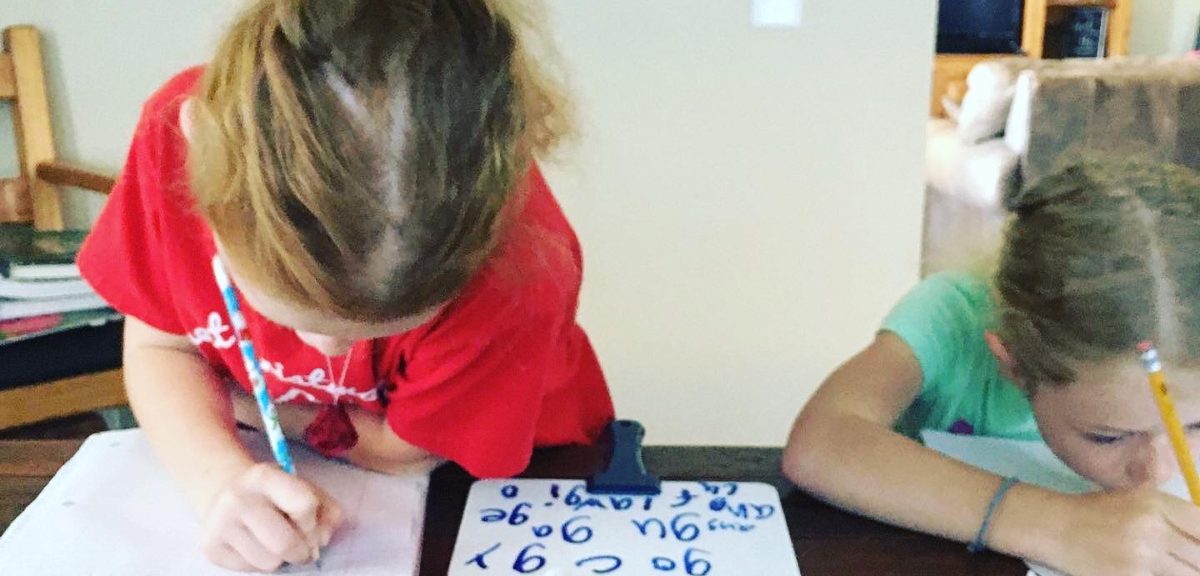
Yes, they did their own hair this day! They were SO excited to do Phonics together today!

Phonics is the first step that all of the oral work with language takes toward building a strong relationship with written language. The word phonics is based on the root phon or phone which means sound. You may remember from my post on Phonemic and Phonological Awareness that the suffix -ic means “having to do with or in regards to”. That means at its “root” (pun intended!!) Phonics just means having to do with sound. And that is what it is. It is teaching children what sounds each letter makes. ALL of the sounds each letter makes (long and short vowel sounds, soft and hard c and g sounds, or multiple sounds for a digraph). It is also what sounds different digraphs, trigraphs, quadgraphs, diphthongs, and vowel teams make.

Here is some more information about what each of those letter combinations are. Di-, tri- and quad graphs are just letter combinations that make a new/different sound. Di is a root that means two, so these are the two letter combinations of sh, ch, wh, and ph. Tri means three so that includes combinations like igh, tch, dge. Quad means four so that means a four letter combination like eigh. Diphthongs are vowel or vowel and consonant combinations that make a blended or new sound. Some examples of these are ou, ow, oi and oy. Vowel teams are two vowel combinations that follow the rule of “when two vowels go walking, the first one does the talking and says its name”. The term vowel team is used for various combinations in different programs and trainings, but to me there are only 6 true vowel teams because they include only vowels and they follow the above rule. They are ea, ee, oe, oa, ai, and ie.

Once learners have mastered with BOTH accuracy and automaticity the sounds of the letters, they can start using their Phonemic Awareness skills to put those sounds together to sound out AND spell words. This is a key thing to remember. True phonics should include instruction in both decoding (reading) and encoding (spelling) words. Learners do not have to have all the letter combinations mastered before starting to use phonics to read and spell. In fact they can begin using their Phonological skills to read and write as soon as they have mastered with accuracy and automaticity as few as two letter sounds like /a/ and /m/ or /o/ and /n/. As learners are working on and mastering their letter sounds they should be using them to read and write as soon as possible. Doing this will help their learning in two ways. First, it will help them see the value of what they are learning and help them remain engaged in the learning. Second, it will help ingrain their learning deeper as they practice applying their new knowledge in different ways.

This is essentially all that Phonics is. It is teaching learners explicitly the sounds that go with each letter symbol and then giving them as many and as varied opportunities to use/apply that information in BOTH reading and writing. There are just a few more things I would like to mention though, that strengthen a good phonics foundation.

One of those things is the rules that govern many of the sounds letters make. Although, typically these rules are more important for spelling, they do affect reading skills as well. One of the rules that affects reading is the type of syllable you are reading. A closed syllable (one that ends in a consonant) uses a short vowel sound. An open syllable (one that ends in a vowel) uses a long vowel sound. Recognizing and understanding this will help readers gain efficiency because they no longer have to try both vowel sounds, they can just read the correct sound the first try. There are between six and eight syllable types depending on the program you are using or learning from. Each of these syllable types gives specific information to help with reading and spelling. A strong foundation in Phonemic Awareness is again important here because it will allow children to know where words break between syllables. Other rules like an a says /o/ when it follows a w or comes before an l, help with both reading and spelling. Words like want are no longer just sight words, they are words that follow a specific rule. This is an example of how, although there are certainly exceptions to the rules in the English language, there are fewer than many of us think or thought, once we learn the rules that govern our language. I am only now starting to feel like I know about more of these rules than I don’t thanks to a mentor of mine who is a Dyslexia interventionist and whose original degree was not in teaching, but in English itself. It is vital that there is instruction in these rules that govern our language within Phonics instruction to ensure students can read AND spell unknown words based on rules and sounds, not just the words included in the lessons or weekly spelling list or the word list in the back of their decodable reader.

The other is the VITAL importance of teaching spelling as a part of Phonics instruction. Yes, this series of posts is about the pillars of Reading, but without using Phonics for spelling you are taking half of the equation and ability from the learners. Students will progress more quickly with reading the letter sounds they are being instructed in than they will in spelling them. However, once they have mastered letter sounds and practiced applying that knowledge in reading they need to be given the opportunity and expectation to use that same knowledge in writing/spelling. If they cannot use the known letter sounds correctly and consistently in spelling and writing, both scripted like a spelling test and free like journal writing, it should not be considered a mastered skill and more practice must be given.

Here are some things to remember about Phonics:

It is the explicit instruction of letter and letter combination sounds

It must include application practice in BOTH decoding/reading and encoding/spelling

It must include instruction and drill of the rules that govern which letter/letter combination sound OR letter/letter combination to use when spelling a sound (i.e. both ch and tch say /ch/, but are used in different words and places in words)

If you have any great tips to share about teaching Phonics to your students please share in the comments so that we can all learn from you! What has been your best resource for learning the rules that govern our language? What questions do you still have about Phonics? I look forward to hearing from you.

EducationRamblingsResourcesScience of Reading

Fluency, Everything is Coming Together!

As I dive more and more into the Science of Reading, I am actually surprised that fluency remains one of the pillars for reading. Before you jump to conclusions that I’ve lost my mind or any understanding of what reading has to accomplish to be successful, let me explain.

First, I would like to say how grateful I am for the chance to write these posts. What started as a way to help readers, specifically my sister, understand more about reading as they work to help children learn to read, has become a way for me to understand reading better and organize my thoughts more about it. Writing these has helped bring more clarity to each piece of reading and the way they fit together and I am SO grateful. Having that clarity gives me more focus and the combination of the two will help me to do a better job of helping my daughters and my students traverse the sometimes rocky terrain of reading.

Back to fluency and explaining my thoughts on why it seems odd as a pillar of reading. First, why I think it remains a pillar. To be sure you must be a fluent reader to comprehend well. Fluency is also what takes reading from a lesson or a chore to a pleasure and an adventure. And these facts are, I’m sure, the reason it IS one of the five pillars of reading. The reason I say I am surprised that it is left as a pillar is that the more I read and learn about the Science of Reading, the more I realize that fluency is a byproduct of accuracy and automaticity of the foundational skills of reading.

To kind of paint a picture of this, I find it helpful to think of Scarborough’s Reading Rope which is based on the Simple View of Reading. The Simple View of Reading says that reading is made up of two parts: decoding and language comprehension. Decoding is a blend of Phonemic and Phonological Awareness. As a learner becomes accurate and automatic in both of these skills, they become a quick and efficient Orthographic Mapper. Once they become an efficient orthographic mapper, they build a larger and larger sight vocabulary and reading becomes more and more effortless. This then adds the third element of decoding which is sight recognition. This would reach by many definitions or assessments fluent reading. Strength in these three areas alone would give students a high score on tests like DIBELS ORF, it would aid them in the timely completion of STAR and MAP tests. But, without the other half of the simple view of reading, all of these abilities come to naught. That is because if all the learner has is decoding fluency then they cannot understand or remember or apply anything they read. Reading has become almost rote memorization. To me this drains reading of all of it’s color, drama and interest. It truly just becomes the job that so many struggling readers see it as. Interestingly enough, most struggling readers see it as a dreary chore, not because of a strength in decoding alone, but rather a deficit in decoding even if they have a strength in Comprehension. This leads us to the other half of the Simple View of Reading.

The second part of the Simple View of Reading is Language Comprehension. Now, like was discussed in my post on comprehension, comprehension is truly the understanding of BOTH what one reads AND what one hears. That is why it is called language comprehension in this view and not reading comprehension. According to Scarborough’s Rope, Language Comprehension is made up of background knowledge, vocabulary, language structures, verbal reasoning, and literacy knowledge. As you can see very little of this comprehension is actually based on reading. Rather it is based on talking. That is why when a teacher is trying to help students grow in comprehension their lessons must include lots of conversations. It is also why we need to facilitate conversations with our students, with our children at home, with our nieces and nephews and grandchildren. The more they talk and the more words they are exposed to in conversation, the greater their reading comprehension will become. This is because they then already have a foundation of strong knowledge of word meanings. Then as that Comprehension or knowledge of meanings is mixed with their decoding skills of Phonemic and Phonological Awareness and Orthographic Mapping then a reader is truly FLUENT. They are able to read accurately, with a natural rate of speed AND with the appropriate expression based on their understanding (comprehension) of the text.

Here’s a recap. Fluency remains a pillar of reading because without it reading doesn’t work. However, it is a pillar that, even more than the others, CANNOT stand alone because it is gained only through the development and success of the other pillars. Therefore, fluency rarely if ever needs to be targeted for remediation or intervention. It will naturally occur as you strengthen the other skills necessary for reading. It stands as a good example and important reminder that NONE of these pillars are meant to be alone. There are five pillars because the institution of reading cannot be held up by any one of them. If a learner is only strong in one, then that part of their reading will stand tall, but it will always be skewed as the other parts fall and slide and slant every which way. Fluency sets the example and the is the final marker of how reading is the coming together of five key parts to create one whole and balanced reader!

Happy reading! Let me know of any examples you have of seeing fluency grow, not from explicit fluency instruction, but from a learner growing either in a deficit pillar skill or in all of them simultaneously. I look forward to hearing your success stories, both to learn from you and to celebrate your victories!